Lessons Learned

Instructional Technology - International Education - Wellness

Category: Communication (page 2 of 9)

VS – Weekly Planner Grade 3

The grade 3 team splits up the curriculum writing and shares out a central planner with their students. You will notice the term “packet”. We started VS going fully digital. With the big shift from face-to-face to virtual learning, some of our parents asked for paper lessons when possible. The spatial difficulty of trying to find SeeSaw posts, Google Docs, etc. was a little too much compared to having paper copies to work through. We then began a bi-monthly packet pick up at the front of our school. Interestingly enough, as we move further into VS with the government-mandated social distancing, we might not be able to print and hand off copies in person as we did previously. But as our students and parents are now VS veterans, I think they will be able to handle the shift back to fully digital lessons.

Lesson Learned 1- I really appreciate that the team has the wellness component of supporting a growth mindset embedded into their planner. A growth mindset was already a part of the grade 3 culture due to the leadership of Patrick O’Donnell so it was easy to continue the lessons virtually. If it was up to me, I would have wellness as a listed area of study for every grade level in their weekly planners. And as stated previously, I know just the fella to help to co-design the lessons and activities. 🙂

Lesson Learned 2– This application of applying distributed expertise to divide up the work and communicate through one channel is what we did at HKIS during SARS in 2003. I think it is one way to be more efficient and productive while also facing the reality that virtual school can last a long time. As noted previously, fatigue sets in without the daily energy provided by face-to-face teaching.

Note the category of “Super Unit” down the left side of the last table. Super unit is our term for an interdisciplinary unit of study. My additional lesson learned is that virtual school doesn’t mean one gives up on collaborative, PBL, and concept-based learning. You just need to really design the heck out of it just as Mark did with the eBook and I suspect the diorama video mentioned below. I am a real believer in designing and publishing the unit of study project in a web module for easy access by students and parents. It also gives them one place to access all the directions and resources. Some of you might be thinking about how WebQuests fit this description. I could not agree more. 🙂

Thanks, grade 3 team for sharing some of your creativity!


VS- Lots of Organization Designed into Communication

A common delivery theme across all the grade levels at m school is the packaging of assignments with very clear directions and checklists. The teachers get one shot in their communication to bring about the most understanding. If they fail to some degree, they receive a barrage of questions. Design literacy to fluency is pretty important in our virtual teaching toolkits.

Here are two communication samples from the fifth grade. Notice the first graphic has the agenda for March 20th and on the left side is the longer-term checklist for March 27. Also notice in the second graphic how Ken started adding a daily BIG FOCUS to help his students prioritize their actions. Both were sent to students via SeeSaw.

Lessons learned– The first week or so of virtual school is similar to starting the regular school year. You are introducing the structures, protocols, and systems of how your class will operate. The plus is that your students will be able to engage their growth mindsets and ramp up their self-direction and organizational skills. We talk a lot about guiding students to be more independent. Virtual school offers this opportunity.

The negative is that the students are sitting at home in front of a machine that can distract them every which way possible. Connecting to parents/caregivers to help with this process is huge. With so many parents staying home around the world, this is another opportunity we hope for parent engagement in the learning of their children.

Be ready to be patient as you help guide your two sets of learners (i.e., students and parents) to be problem-solvers.


Virtual School – Different Types of Communication for Different Needs and Hitting the Pause Button

-Communication-

When you look at any handbook for top priorities in handling a crisis in a school community, the number one priority is to set up clear communication from the head of school to the community.

We are fortunate at my school that our head of school, division principals, and communications team are on top of letting the community know the latest information about virtual school and where things stand with the hopeful reopening. They provide information from the government, strategies to support children studying at home, and health information while also offering reassurance that we are all working together for the benefit of our students and parents.

Our head of school communicates via email and videos. Her videos are especially helpful in making a personal connection while providing a visual image of her leadership in action.  What pops into my head as a history teacher/wellness coach is the voice of President Roosevelt doing his fireside chats. President Roosevelt communicated during the crisis of World War II to bring encouragement, stability, and hope into the lives of the citizens.

With no end in sight for our virtual school and terrible news coming from Europe and North America, I definitely see the need to have our head of school and other leaders provide some sort of fireside chats to our community. We can ask the parents to send in their questions to guide the content of the talks.

Another type of communication in the case of a public health crisis is education for both mental and physical health which we combine under the PERMAH  wellness construct. In the case of my school, the nurse and I take turns posting articles, write-ups, and tips to support the well-being of our staff. We have not opened up the wellness blog to our parents so I hope we can find some way to share needed information with them as well as our students. Something as basic as creating and sharing a video on hand washing which the nurse and I did back at HKIS during SARS is just one way to provide health information to the community.

-Hitting the Pause Button-

While we are fortunate in Vietnam to have limited cases of the coronavirus, we are now in week six of virtual school. Fatigue is setting in for some so it is definitely time to pause, reflect, consolidate and re-calibrate what we are doing and how we will go forward. We are entering a new phase of virtual school with Europe and North America now being engulfed by the spreading wave of the coronavirus.

A few guiding questions for this reflection process could be:

  • What aspects of our efforts are really working well for our student learners? Our parent and nanny facilitators?
  • Which delivery strategies have the greatest return on investment of time and energy with our efforts?
  • Which is offering the lowest return?
  • Are we using technology to meet our pedagogical needs or are we adapting our pedagogy to the tools?
  • Where are our staff, students, and parents regarding their stamina and endurance for the possibility of extended virtual school?
  • We started off with a sprint and we are now in a marathon. Have we adapted? Do we need any course corrections?
  • How intentional are we in making wellness a priority for our community?
  • How are our actions supporting our desire for our collective well-being?
  • What could happen next in Vietnam and in the world that we need to have contingency plans ready for?

One observation for me is that boy howdy we have an incredibly talented and driven group of educators at my school. They dove into the shift from regular to virtual school with a passion to serve their students and their parents. I previously wrote about how I saw several of the PERMAH pillars in action during virtual school at HKIS during SARS. I see the same positive benefits today seventeen later. The wellness benefit of the PERMAH “A for Accomplishment” really stood out back at HKIS and it is the same today.

One big difference between the HKIS virtual school and my current school is that we ran for a month in Hong Kong and now we are in week six not knowing how much longer we will be doing online learning. With no clear end of virtual school in sight, we find ourselves working hard and definitely accomplishing a great deal. But my observation is that we cannot continue to pound away at achievements as a source of energy to support our well-being.

The staff at my school has been pushing forward using lots of energy to the point that it seems like our collective energy reserves are running low. Our normal recharging through face-to-face teaching is obviously missing and we need to acknowledge this.  As we pause and reflect on how we are doing virtual school, I come back to my previous posts and article on the importance of supporting the social-emotional needs of the community. A big lesson learned from HKIS is that the longer virtual school lasted, the more the social and emotional needs of students, staff, and parents became our focus. Back to the present day, it definitely feels like we need to take our collective foot off the gas pedal to find ways to re-energize. One might say that we are in need of an intervention.

As one colleague says, we need to do some “tuning” of our lives to find a balance between our commitments to students, our teaching partners, our parents, our own families, and most importantly ourselves.

Something tells me that educators at the other Asian international schools that closed when we did are experiencing the same revelation. It seems that we need to shift our emphasis from accomplishments to other PERMAH pillars to support our individual and collective well-being. I think the R for Relationships is a good place to revisit while spending time on the character strengths of emotional intelligence and social intelligence.

Photo by Perry Grone on Unsplash

Virtual School – Class Time! Engaging the R in PERMAH

“OK, who can answer that question?”

Mr. Howe facilitates his virtual classroom helping students to connect with their learning community. Thanks, Rob for letting me observe your class!

Virtual Elementary School – Looking Back To SARS in Hong Kong

With the outbreak of the coronavirus in China and its spreading to other locations outside China, we are seeing both public and international schools closing in Asia. The response to the SARS epidemic in 2003 was similar. At that time I was the instructional technologist for the Upper Primary of the Hong Kong International School (HKIS). I vividly remember the sense of despair and anxiety in our staff trying to make the decision whether to stay in Hong Kong or travel to their home countries. Our parents were desperate for information, especially about how to provide stability and emotional support for their children.

Moving to the present day, I did some reflection this past week about the needs of the students, parents, and staff if our international school might need to close to then go virtual. I am also seeing other folks thinking about virtual school and posting some helpful guidance on tools and platforms that schools can leverage when going virtual. Our menu of tools at HKIS in 2003 was very limited but our focus was not on the technology. Here is a bit of our story.

Our head of school sent out the announcement that the HKIS would close. Those staff members who had not already left Hong Kong leading up to closure were figuring out their next move. We realized that closing the physical doors to our school was not our only option. We could open virtual school doors to our community. We realized that with the majority of our students being local that many would be holed up and isolated in their apartments and houses for who knew how long. It was also clear that their days would probably be unstructured which would only increase their anxiety and that of their parents.

The idea of going virtual was not much of a sell to our principal Bruce Kelsh. His response was to tell me to form a team and to get started immediately to create our Upper Primary Virtual School. The Middle and High schools jumped on board and we began to make our plans. To learn more about those experiences, here is an article describing the effort and some of the lessons we learned.

Now firmly in the present day thinking about what might happen next with the coronavirus, I am putting together a list of ideas for my elementary school. Here is what I have so far.

Virtual School (VS) Lessons Learned from HKIS During SARS

  • Virtual School Leadership Team. Create a leadership team to design the overall plan to then work with and guide the grade-level teams and specialists into implementation. One might not just go with current leadership structures. It depends on what the main responsibilities of the team will be. In our case at HKIS, we needed green hat thinkers who also had experience in using technology. We were a school that used de Bono’s Six Hats thinking approach which could be a helpful framework for our VS leadership and grade-level teams. We also had folks who brought their skills in logistics, communication, facilitation, etc. to the leadership team. Make sure to have a counselor/psychologist on the team to bring the lens of wellness to the discussions and actions.
  • Virtual School Plan. The first task of the VS leadership team at HKIS was to construct our VS plan of operations. We began the process by recording lots of questions and “what if’s?” This is where we are fortunate at the ES to have so many facilitators and program developers. Note that the VS plan documentation is an ongoing process. You can get your initial goals, roles, and systems in place. However, your learning, reflecting, and adapting are ongoing as you get feedback from teachers, students, and parents. So be ready to keep your plan up to date with built-in markers to pause, reflect and make changes. All the documentation will obviously pay big dividends down the road if and when you are forced to reopen the virtual school.
  • Pedagogy came first– not technology. Our guiding design process at HKIS centered on what we called the Three C’s: Communication, Community, and Content (Interactive). We reviewed the everyday literacy, math, etc. lessons and unit projects (similar to our super units) through the SAMR and TPACK filters looking to create lessons that would have our students easily communicating (and collaborating) with each other and their teachers, building SEL connections (community) while engaging with the interactive content to then move into creating with or without technology. If we are to take a similar approach I would drop the SAMR as it can be confusing for some. A cleaner and simpler approach is Replace, Augment and Transform (RAT). I add “amplify” to augment as we help students share their learning with a greater audience.
  • The Instructional Technologist (Instructional Coach for Technology): This is obviously a key role today just as it was back in 2003. I have written a lot about this role with real emphasis that your instructional technologist must be allowed to apply his/her training as an instructional designer and facilitator of the curriculum development process, especially in the case of virtual school. What I have seen happen in the past few years with the growth of more and more educational platforms is that the instructional technologist is in some cases returning to the pre-2000 role of technology coordinator. Back in the day, the tech coordinators were definitely the “tech guys” who were mainly technicians making the computers and printers work. Today I am seeing the instructional technologist not only managing educational platforms and accounts but also being the caretaker of hardware as in iPads, robotics labs, etc. So let your instructional technologist dive into the TPACKing process of guiding teams to work as designers bringing their content, pedagogy, and technology knowledge together to create the lessons and unit projects. If possible, as part of applying individual skill sets in various roles, get your Dreambox, SeeSaw, etc. teacher experts to provide that type of support while their grade-level partners carry more of the curriculum development work. And of course, this designing and creation process is going to be fluid with some getting-started needs that will diminish as teachers feel more comfortable using various technologies.
  • Collaboratively develop uniform lessons by grade level teams as opposed to having each teacher go it alone. At HIKS this led to more buy-in from staff feeling the work to be less daunting while benefiting from the more efficient use of time, distributed expertise of teammates, and creativity of teamwork. The leadership team designed protocols and frameworks to help provide a uniform presentation of curriculum and experiences for students. An additional principle was that we tried to break lessons into simpler portions as we obviously did not have the benefit of face-to-face explanations with our students. This leads to thinking about how we do build a system for students to ask questions of each other and their teachers.
  • Communication Conduits. Connecting to uniformity for ease of understanding by our stakeholders, we also had protocols for handling information requests, needs for extra social-emotional support, setting good boundaries with parents, etc. The admin team at HKIS had very clear structures on who spoke for the school and when information would go out. This is a larger issue that our admin already has in place but we will need guidelines for parents emailing grade-level teaching teams for information and requests.
  • Distributed expertise led to teachers taking on various roles engaging their skill sets as handling the web work, parent communication, liaison with the Virtual School Leadership Team, etc. This approach benefits from having very upfront discussions with team members about their strengths and weaknesses as to where they can best apply their skill sets.
  • An added wellness PERMAH benefit at HKIS was that virtual school also connected our teachers who had left with those of us who stayed in Hong Kong. Teachers had more positive emotions due to the relationship building of the grade level teams engaging in creative work leading to flow as well as feelings of achievement and satisfaction of contributing to the well-being of our students and their parents. It was also very evident that giving teachers opportunities to engage their strengths and skills also added to their well-being by connecting to the E and M of PERMAH. Admin provided ongoing emotional and informational update support for staff as well. Moving to the present day, I would introduce the term wellness to our communications while providing a curriculum to help our students and parents better understand how to handle their feelings of fear, anxiety, isolation, etc. that arise in crisis situations. The nature of Positive Psychology is to focus on how to equip ourselves to engage our character strengths within each of the PERMAH pillars to enhance our well-being and thrive. It is important to note that the same efforts must be provided to support staff with their wellness needs as they deal with the isolation that comes from a virtual school. I would recommend that a wellness/self-care curriculum be developed for staff that is offered face-to-face and/or virtually depending on the status of being on campus or not. It is obvious to point that teachers and students get so much energy from being with each other. The loss of energy and potential of experiencing more negative emotions becomes more and more evident with the loss of daily classroom routines and face-to-face contact during the longer virtual school runs. As for the present moment, we already have our PERMAH and Character Strengths lesson idea resources on the web and ready to roll. We can take small steps limiting the language of Positive Psychology and PERMAH by simply using the terms our students know as the value of relationships, the positive feelings that go with accomplishment, and the strengths of being creative and self-understanding for example. One structure to support this process would be to designate a wellness or SEL lead on each of the grade-level teams. This person would work with me to design SEL activities that would be a part of the regular curriculum just like the regular subject areas.
  • Self-Management and Study Skills. It goes without saying that students take a leap in their development around self-management skills and the character strength of self-control. Our younger students of course need a great deal of parental supervision while our upper primary students are more self-reliant to some extent. The virtual school puts our students into an entirely different learning environment with limited interaction with their teachers. One support mechanism is to provide lesson(s) to help students construct their daily learning plan (i.e., goals, task listing with time expectations, use of a timer, etc.) that includes breaks from technology with designated wellness breaks. The wellness coach (counselor) could support the effort by creating a website of wellness activities for students, teachers, and parents to draw from. A guiding principle would be to get everyone, including teachers, to take nature breaks several times a day.
  • Interdisciplinary Learning. Our specials teachers at HKIS were a big part of the design effort to offer integration and standalone learning opportunities for their content areas. They came up with lots of creative and FUN activities for students to do. The librarian played a key role in providing online resources of databases, reading resources, etc.
  • Our Coaching Model. The instructional technologist, the science coordinator, and the librarian led the VS leadership team at HKIS. We are fortunate at the ES to have three coaches, learning support teachers, two counselors, and EAL instructors to help lead and share their areas of expertise collaborating with the VS leadership and the grade-level teams in their design and implementation work.
  • Web Resources for Independent Learning. We did build a section of our web presence to house links to online resources for students to explore on their own. We need to remember that our regular curriculum will only take up a portion of our students’ days. The supplemental enrichment resources at HKIS offered self-directed learning opportunities that included inquiry and research. I am reminded that we also had a section for parents for their FAQs which cut down on the need to respond with full explanations to parent emails. Our leadership team would need to decide whether to have one central listing of sites broken down into categories and age-appropriate sections or to have each grade level have its own resources page. Connecting to having roles on the grade level teams, one role can be the curator of web resources. Here is one listing of web resources divided into four themes. There are many other curated lists that we can draw from.
  • Social and Emotional Support. Our biggest lesson learned was that through the structures, systems, and connections of VS that we helped our students and their parents feel a part of a community. I cannot stress enough how important this was. One needs to recognize how isolating it was for some of our families who chose not to go out for walks and visits with others. Other parents chose to not be so isolated. As noted in the article, some students who lived close together would congregate at someone’s home for their face-to-face version of school interacting with our VS curriculum. Some parents organized the day into blocks for LA, math, social studies, etc. Note in a couple places in this post that our staff also benefited socially and emotionally with their running of the virtual school which offered routines and ways to engage with the pillars of PERMAH. Do understand that the longer virtual school runs, the more social and emotional support takes precedence over other goals and academic needs. So we should look at every opportunity to have our students interact with each other. The interaction can take place in virtual synchronous morning meetings, sharing photos, recorded audio and video messages, working in teams on projects, and so on. Simply find ways for shared face time! I also would definitely broach the idea going forward to work with staff, students, and families to create some sort of wellness plan using PERMAH and the Character Strengths. Goal-setting within the PERMAH pillars with supportive action steps could be a part of the wellness plan template.
  • Social and Emotional Support for Staff. Just as in regular school, the administration needs to be out and about nurturing connections, taking “moral temperatures” and cross-pollinating ideas. The art of active listening through acknowledging, validating, and celebrating more than ever must be taking place as achieving and “stretching” teachers need support with their well-being by school leaders. As mentioned, I would also look to form a wellness support team to come up with self-care and morale-building activities if we are able to work from school. We could definitely put together a menu of “afterschool activities” for staff if we get to work from school. We also need to draw on the expertise of the counselors/psychologist and outside-of-the-school mental health providers to provide information about mental health and how and where to get support, if needed.
  • Parent Buy-In to VS and Their Role as Teachers. This happened naturally but I would make it more intentional in our effort. We could possibly put a parenting/teaching set of guidelines together. We would also need to do the same for nannies if the parents are going to work. And note that some families will choose not to participate and/or be sporadic with their engagement.
  • Delivery Tools and Platforms. The intent of this write-up is to not list the delivery tools we used at HKIS. There are so many good ones to choose from now. What I would think about is how to package research assignments and super unit projects. One approach would be to use some adaptation of WebQuests especially when inquiry is involved. To the point of keeping the directions simple and clear, it makes sense to think of formatting the learning in some sort of learning module for “one-stop learning”. While WebQuests have been around for over 20 years, they check a lot of boxes for clear task and rubric identification, collaboration through roles, inquiry, higher-level thinking skills, and learning project creation. They also make the research process simpler by providing a listing of resource sites within the learning module. And regarding tools and platforms, it is helpful to have either a central or by-grade-level virtual school toolbox for students and parents to access tutorials for all the technologies. Also, make sure to have one central posting place for assignments whether on a weekly or bimonthly timeline. In using a variety of tools for different purposes such as creation, curation, collaboration, and/or communication (i.e., Information and Communication Skills- ICL), it can become confusing for students and parents to know exactly what is expected and when it is due. So make sure to have the central assignment place for easy reference whether it is in your LMS. Google Docs or a website.
  • Cross-Pollination. Just as in regular school, we had pockets of innovation taking place within grade-level teams. It was my good fortune to watch creative teachers find ways to design learning activities that supported our “Three C’s” approach while I also was able to share their ideas with the other teams. As mentioned, at the ES we have a great many coaches and specialists who can bring their skills to each team while picking up innovative approaches to carry and diffuse out into our learning community. It made sense for us at HKIS to start slowly helping to guide our students into learning virtually. But as our students got the hang of things so did we which led to richer and deeper learning experiences.
  • Opportunity. Our experience during SARS at HKIS was difficult at times. Thankfully there were no cases of illness within our community. Instead of allowing hysteria and troubling emotions to rule our thoughts, our community like many when facing challenges, worked together to make the most of the moment to shine and to excel. Disruption and challenge definitely can provide opportunities to reflect and engage our growth mindsets to then charge forward. This was the case for some of our teachers who tended towards a bit of a static mindset. I can still see several of their faces beaming at what they accomplished especially when previously being reticent in using technology. Many of our students made leaps in their development becoming more self-driven and independent. Our early adopters who sometimes did not get recognition for their creativity and innovation really shined when given the opportunity to showcase their ideas.
  • Reentry and Reflection. Build opportunities for students and staff to reflect on their experiences during virtual school. There is of course the social-emotional processing that needs to take place. The very positive personal growth also deserves time and attention. Back to the theme of disruption, we learned that with positive attitudes and growth mindsets students and staff found ways to engage their character strengths and skill sets to experience real personal growth.
  • Transferability. We learned a lot about differentiation through innovative pedagogy delivered via technology when not able to provide face-to-face instruction. Many of our quiet students found their voice thus growing their confidence by fully engaging in virtual learning. Some of our teachers found ways to continue aspects of their online content and activity work thus moving into more blended instruction during regular school.
  • Co-Curricular Learning. After-school activities were a major part of the learning taking place at HKIS. From orchestra to sports to crafts, you name it, we had teachers and contractors providing engaging learning opportunities after school for our students. I cannot remember if we offered some of the activities virtually during SARS but I can say I would definitely try to find a way to include them in some fashion in the present circumstances. Disruption leads to opportunity so I can see after-school providers finding ways to virtually connect with students to run their activities and keep their businesses afloat. As noted, the SEL needs of students to be connected with one another and to participate in energy-providing activities that lead them to engage their Character Strengths (i.e., creativity, curiosity, social intelligence, etc.) means that we really should think about how we can deliver the benefits that co-curricular learning offers.

___________________________________________________________

After virtual school at HKIS, we started running an annual practice week of virtual school in which all members of our community practiced virtual learning. Here are some questions that came up in one of our initial planning meetings. There is some overlap with what is covered earlier in this write-up but some of the questions offer new insights.

  •     What will your online assignments/lessons look like?
  •     How will they support what you normally would be covering in class?
  •     How will they involve cooperative learning?
  •     How will they be project or problem or inquiry-based?
  •     How will you avoid fluff work?
  •     How can multimedia teacher-created lessons engage students more than static worksheet ones?
  •     How will some assignments involve doing research that the student can access online?
  •     How do we continue our normal curriculum?
  •     How will you build community?
  •     How will you support one another?
  •     What would our enduring understandings be if we should close down?
  •     How would we reach those understandings through the curriculum?
  •     Who would be responsible for what areas?
  •     Then what technology will support what we want to do?
  •     And how can the TAs help us?


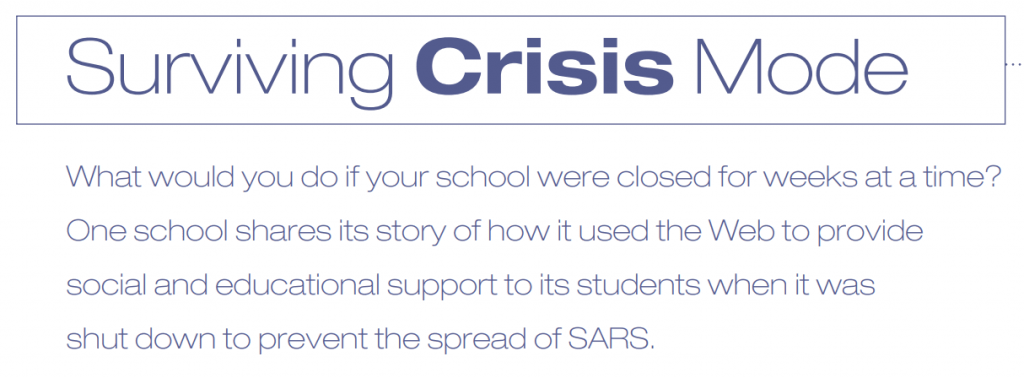
Image Source: Learning & Leading with Technology. Volume 32. Number 8.

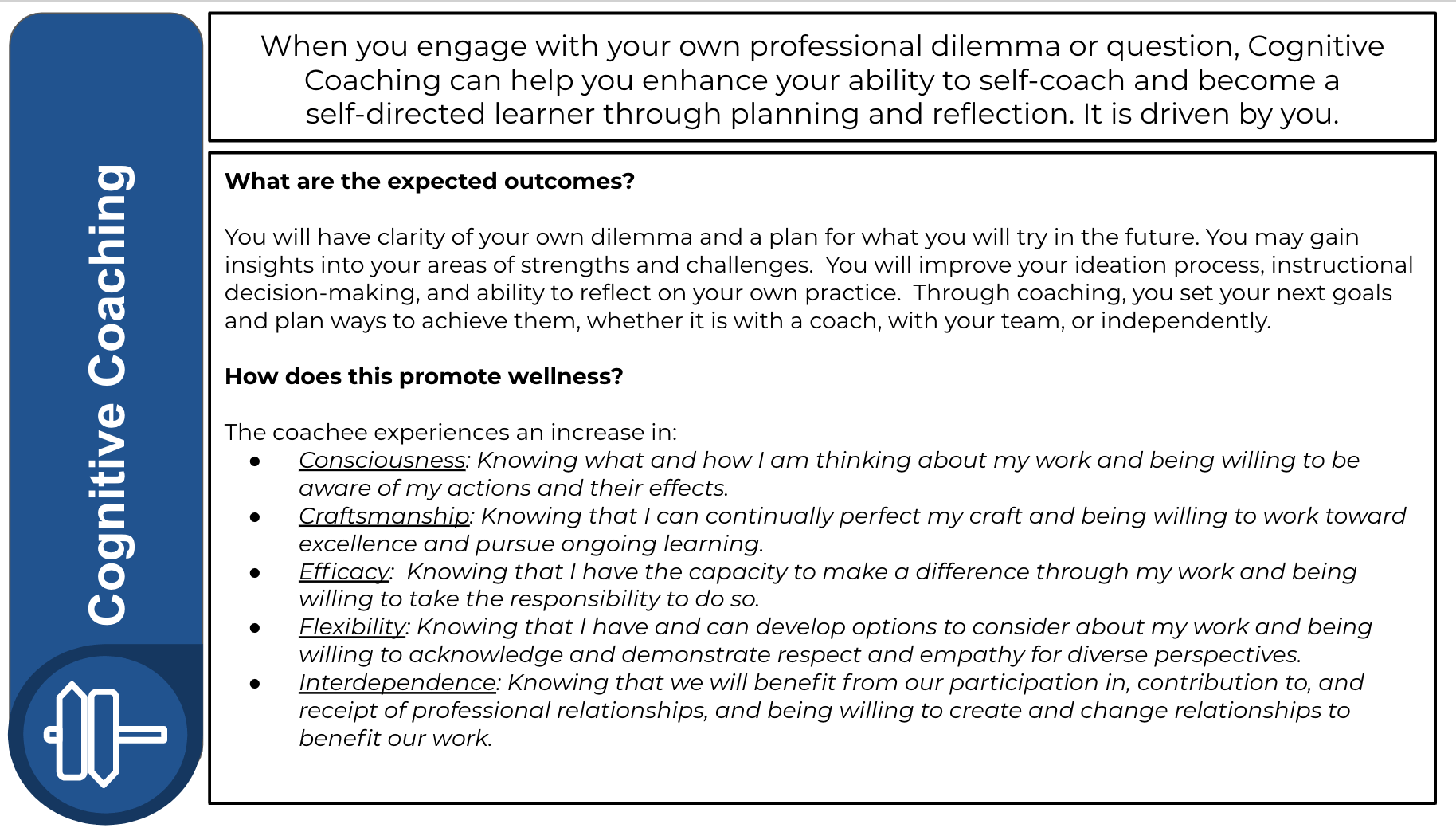
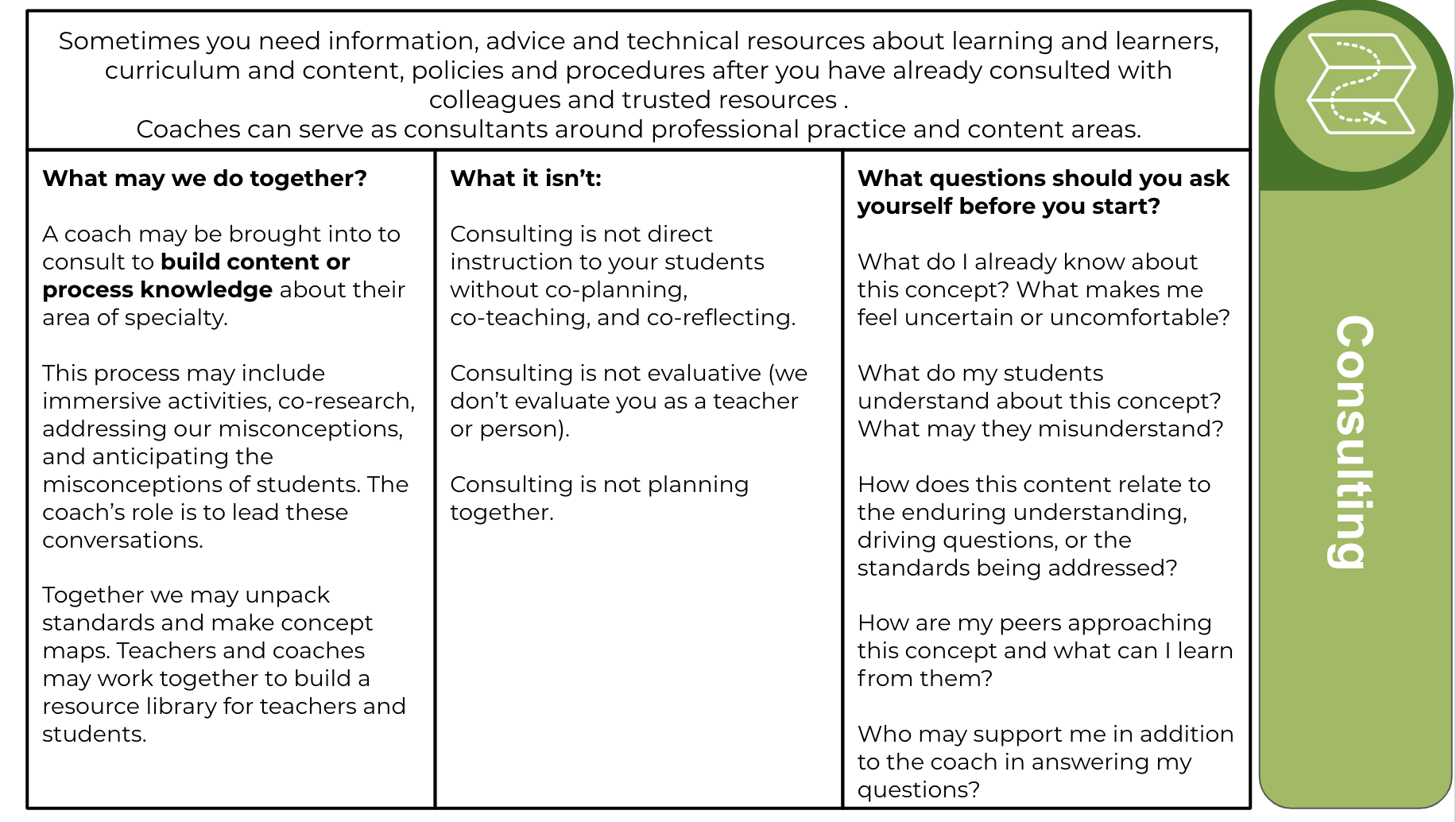
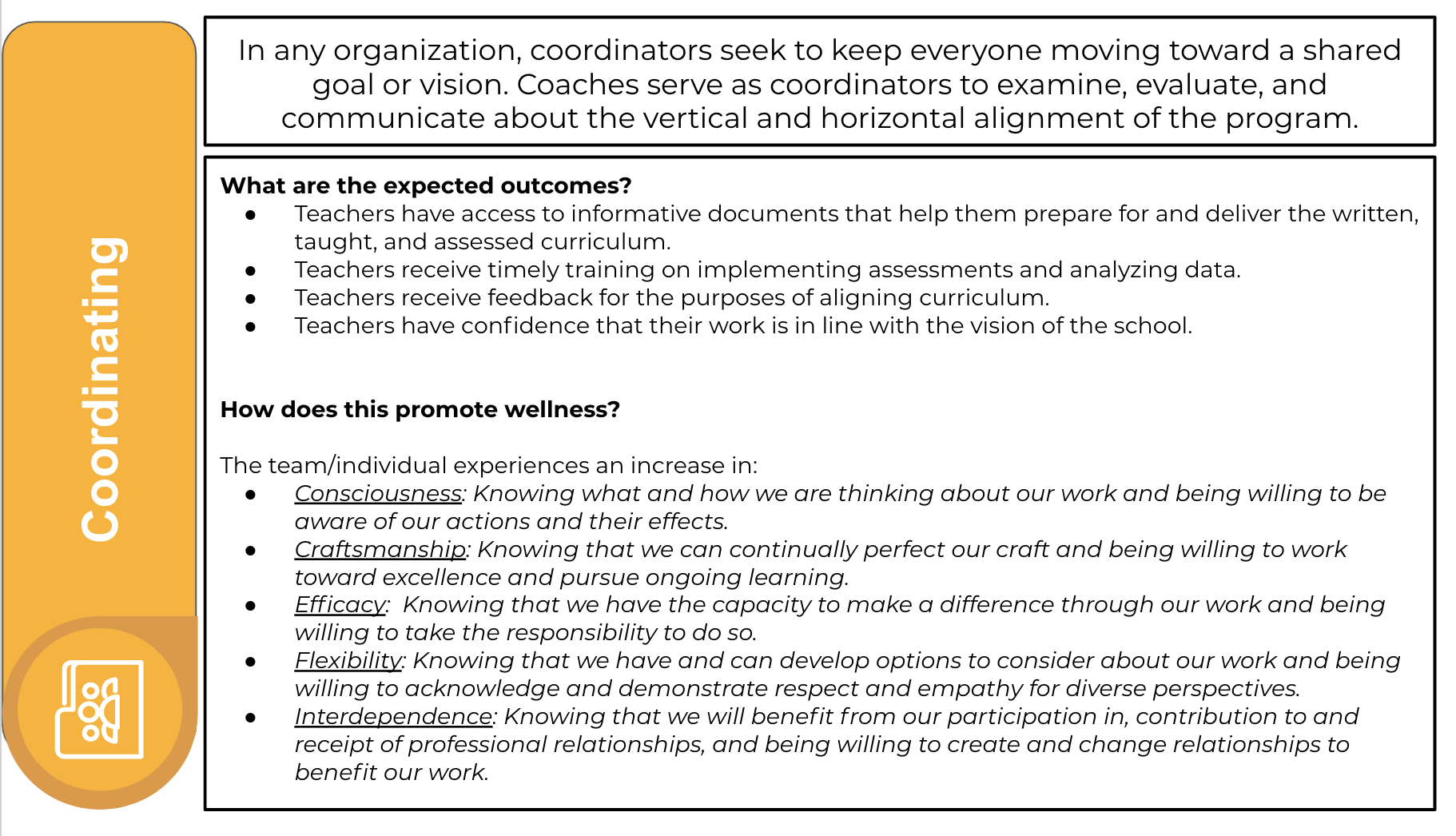
Instructional Coaches – Stances

Today our instructional coaches (Evelyn Lucero, Kattina Fox, and Dave Curran) shared an excellent presentation communicating the main four stances that they when coaching our staff. They drew on materials from Cognitive Coaching while connecting to our wellness initiative.


Celebrating and Sharing with the Community of Learners

How does your school celebrate and share the learning within your community? We have many tools today to do so, including the power of portfolios with students in the authentic role of communicating directly to the community while making their thinking visible.

At my current school, Saigon South International School, I continue to learn via teacher Twitter posts, school YouTube videos, SeeSaw portfolio posts, and good old emails from our math/science coordinator.

In a moment of remembrance, I thought back to my time at HKIS to jog my memory a bit to celebrate our efforts to share the learning. The image above is a screen capture of a page of our elementary Teacher Toolkit resources site where I posted innovative practices that often used technology. The site is now down, but I have a link via the Way Back Machine. I offer the link here to share how teachers used the technology from those days (2003-2004) to enhance solid instructional strategies that stand the test of time. It is something to think of all the new tools we have today to transform learning.

We also had a school blog. Our web portal didn’t have a blogging function. Were there blogging websites in 2003 anyway? Jeff Utecht did start a blog at this same time. I need to ask him what the blogging platform was. So I used Word to make PDFs to make web posts which I uploaded to our website for easy download. There was no comment feature as modern blogs have today. We also had a media server pre-YouTube days, where we posted student learning examples. Here are a couple of examples.

The Market
Grade 3 Daily News Show

Learning Opportunities for All Community Members (Student Support Services & Parent Portal)

The full title for the post is “wellness, parenting, academic learning skills, life skills, learning for all community stakeholders through a variety of conduits and modalities” via student support services and a parent portal. 🙂

The parent portal would be presented to help parents expand their parenting toolkit with a listing of parenting topics, including wellness supported by articles, books, podcasts, videos, parent workshop slideshows, online courses, etc., including a section on parenting in the digital age.

The student support portal for teachers would have a section containing a Web Resources for Learning style toolkit for instruction, assessment, character development, etc., resources. And, of course, there would be a student section with learning resources that could include ways to help students construct their Personal Learning System (PLS).

The roadblock for the parenting section in international schools is language. One way to work through this barrier would be to engage PTA volunteers and high school students interested in service learning. The PTA could form a committee to research parenting resources in the languages of the different parent populations. They also could provide translation services for the portal pages of information as authored by the school counselors and other providers.

High school students can do the same sort of research and translation. It is especially the case in International Baccalaureate (IB) schools with diploma-candidate students needing to do creativity, activity, and service (CAS) hours.

Image Source

Engagement Routines

Using the visible thinking routines is a constructive way to get our students thinking and demonstrating their understanding. Another strategy is to use “engagement routines” in the form of cards presented by Allison Ruttger, a Third Grade teacher at my school. She uses the term “engagement cards,” which she created as individual slides drawing from various sources like Edutopia and the Teaching Channel.

Here is Alli’s slideshow with multiple cards that connect various thinking skills and engagement processes. Helping students with their attentive listening skills run through the routines.

Thanks for sharing, Alli!


Image Source: Alli Ruttger

Orientation Services (Student Support Services Portal)

Offering orientation to new students and parents is a common practice by schools. Going the extra step to provide information before face-to-face orientation meetings makes sense, especially in schools with many turnovers. This is the case for international schools.

International schools provide early-stage onboarding for new staff by digitally sharing resources about local culture, the school, FAQs, etc. Teachers with Instagram and Twitter accounts, where they post information about the learning in their classrooms and official school accounts, can be incredibly helpful in painting the picture for new students, their parents, and new teachers. It seems reasonable to do the same for new families.

I see bringing interested students and parents on board to help the portal design committee to develop the orientation section of the parent section of the portal.

Image Source

Older posts Newer posts

© 2026 Lessons Learned

Theme by Anders NorenUp ↑

Skip to toolbar