Lessons Learned

Instructional Technology - International Education - Wellness

Tag: active listening

Well-Being Daily Practices

I am finishing a class entitled “Self-Care & Well-Being for Helping Professionals,” taught by Dr. Mark Thurston and Mary Elizabeth Lynch at George Mason University in Virginia. Dr. Thurston gave us a choice to choose from three well-being practices to apply each day for a couple weeks. He used the term “consciousness discipline” to describe the process of applying them. They are protocols that you probably have tried or heard about. Dr. Thurston presented them so clearly that I am sharing them here.

  • Each morning when you get up, write down three positive expectations for the day; and at the end of the day, write down three things for which you are grateful which happened in that day just ending. We can think of this option as “brief journaling for optimism and gratitude” (BJOG). For the morning-time positive expectations, let them be things around which you have some control. For example, don’t pick “I expect it will not rain today” or “I expect my boyfriend will be in a good mood.” Instead, you can like positive things you expect yourself to do (such as “I will work on my homework without distractions for two hours”) and things that are more internal about attitudes and emotions (such as, “I will remain patient even when unexpected, annoying things arise”).
  • Each day for the week, try your best to talk about other people only in the way you would if that person were present to hear what you are saying about him or her. We can think of this option as a way to cultivate greater self-awareness about social relationships and be compassionate in how we think about and talk about others. We could call it the “compassionate social intelligence” discipline (CSI).
  • Try to make eye contact with others throughout the day as you listen to them and talk to them. Allow this action to be an expression of your full attention to them. It’s a way to reinforce seeing and caring about others.   We could call it “paying attention with eye contact” (PAEC). (I can see extending this protocol by trying to be a full-on active listener moving beyond just eye contact. Another extension that compliments this process is engaging in Active Constructive Responding (ACR) along with my strategy of acknowledgingvalidatingcelebrating when others share with us.)

Image Source

More PRIME Instructional Strategies

Here are a couple more PRIME instructional strategies for your wellness teaching toolkit>

  • Wellness Partners – How about introducing the term “wellness partnering” (i.e., coaching) as a technique that students can apply to support each other using their knowledge of character strengths? In applying this strategy, students will need lots of time and practice with their strengths of Emotional and Social Intelligence to be helpful partners. Active listening lessons can be a good starting place to help students see themselves as coaches. As you design and implement this strategy, one helpful approach can be the act of students working together to write wellness prescriptions for in-the-moment responsive needs and a wellness plan to be proactive in preparation for upcoming events.

  • Wellness Prescription Writing – Your students probably don’t know what a doctor’s prescription pad is, so the first step will be to teach them what it is. The next step for classroom integration is to develop ways to have students write wellness prescriptions for themselves and the class as a whole when they see a need. You can print out your class-designed wellness prescription pad that can be as simple as just having “Wellness Prescription” at the top, or you can build in some scaffolding with PERMAH and/or Character Strengths listed with checkboxes that need to be applied. Prescription writing can be a very “sticky” tool/idea in your student’s minds as they, in time, can call out responsively to in-the-moment class events to state, “we need to write a wellness prescription for this!”.


Images: Students | Prescription

How Is My PERMAH Today? – Wellness Dashboard

Recently I wrote about using the phrase “How is your PERMAH Today?” as a strategy that engages several of the PERMAH pillars and some of the character strengths. I also included the question of asking oneself the same question in the post. In giving this strategy more thought, I came up with what I am calling a How Is My PERMAH Today? worksheet. It uses the chart from the PERMAH Pivot plan.

I am doing some professional learning with new staff, so I plan to have them first do the How Is My PERMAH worksheet, followed by writing their personal wellness plan.

Once my school moves forward with a wellness program and the language of Positive Psychology becomes a part of the language of learning, the opportunity will arise to teach the protocol of asking “how is your PERMAH Today?” along with some form of an age-appropriate “how is my PERMAH today?” worksheet for students.

Another way to look at this “how is my PERMAH” daily check-in is to think of having a wellness dashboard. Like that of a car, the dashboard has gauges that measure the performance of specific vehicle functions. In the case of a wellness dashboard, I think we can use the PERMAH construct with some representation of performance level and which character strengths are in play or could be in play for the day. If this idea becomes an app, I could see additional features, including physically “dialing up” individual pillars, each with its own color. It would also be helpful to have a menu of activities/strategies for each pillar to choose ways to further engage within each PERMAH pillar.

The character strength of the social intelligence page of my Wellness@ES site has a few intermediary strategies that can move students along to be ready to use the PERMAH question with others and themselves>>>

Active/Attentive Listening – One way to help our students make emotional and social connections with each other is to help them learn how to listen with attention. Design a listening protocol based on the tenets of attentive listening that fits the age of your students. Use this article and this one as a starting place with your design work to teach and embed active listening into the culture of your classroom. Look to integrate active listening into your Turn and Talk activities.

Active Constructive Responding (ACR) – Design strategies to teach the four ways we can respond to good news.

Personal Profile – Students use active listening skills to interview a partner to complete a personal profile organizer. The goal is for the interviewer to start with a few starter questions to then engage their own questions to learn about their partner’s interests, skills, talents, and goals. This activity needs to be scaffolded by grade level. The intent is to practice active listening and to help the students grow their social awareness. Students can, of course, complete the personal profile organizer for themselves to go the extra step to gather insights from family and friends for what they might not see in themselves.


Photo by Antoine Beauvillain on Unsplash


Going Deep with peRmah- ACR and Attachment Styles and More!

How is your peRmah going today? Here are a few strategies for learning, living, and teaching about relationships.

  • Active Listening – Be present and really listen to others.

  • Attachment Styles in Adult Relationships and Active Constructive Responding (ACR) – Positive Psychology dives deep into attachment and ACR within our relationships.

  • Do a 5-minute Favor (Act of Kindness) – Spend five minutes each week helping someone in your network (at home or work). Share information, recommend, or help a neighbor/colleague carry something from the car instead of making two trips.

  • Emotional Bank AccountFill Your Bucket – Use the language of making deposits (not withdrawals) into the emotional bank and adding to (not dipping from) the emotional bucket of others.

  • Forgiveness – “When we are able to forgive another person, oneself, or a situation/circumstance, we are capable of freeing ourselves from a negative association to the source” (Raj et al. 2016)

  • QuestionsActive listening and employing the Active Constructive Responding (ACR) response to good news and information (see below) are shown to strengthen relationships while supporting positive emotions in both the listener and the person at the receiving end of the listening. Dr. Jane Dutton’s research shows that we can employ four categories of questions in our active listening. Replace “work” with “school” for students.

1. Ask Questions that Convey Genuine Interest in the other person

  • What has been the most meaningful part of your work week?
  • What do you most care about in your work? Or what do you most love to do here?
  • What have you learned about yourself at work?

2. Ask Questions that Inject Positivity

  • What gives you joy at work?
  • Who are you most grateful for at work?
  • What makes you feel valued here?

3. Ask Questions that Offer Help and Assistance

  • In what ways can I assist you in your work?
  • What are your most significant needs at work right now?
  • What have others done for you that you found most helpful at work?

4. Ask Questions that Uncover Common Ground

  • What is your favorite hobby or activity outside of work?
  • What are you most looking forward to in the next three months?
  • Where have you traveled that you most enjoyed?

“Self-compassion involves treating yourself with the same kindness, concern and support you would show to a good friend.” (Neff & Dahm, 2015)

Student – Teacher Relationships article for lots of strategies.

Target the Active Construct Responding (ACR) listening technique to acknowledge – validate – celebrate others in your communication – see the chart below.

Cross-posted at Wellness@SSIS blog

Image Source

Active Listening – Figure 8

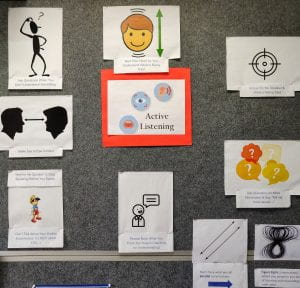
I was chatting with a colleague the other day who noticed the active listening display on the wall of my office. I noted that I needed to add the listening strategy, which covers not having parallel conversations to instead have participants weave in and out of listening and responding to each other. She said it sounds like figure 8. 🙂 Here is the newest addition to my active listening display. Thanks, Tanya!

© 2026 Lessons Learned

Theme by Anders NorenUp ↑

Skip to toolbar