Lessons Learned

Instructional Technology - International Education - Wellness

Tag: school wellness plan

A Community Wellness Program – Now More Than Ever

Time for another Captain Obvious moment. Boy, howdy, do schools need school and community wellness programs more than ever! 🙂 CASEL and other SEL organizations are filling my inbox with messages pointing to the need for SEL support in schools and how education and government leaders now understand just how vital student well-being is for personal development and academic success.

I have written much about the need for school wellness programs to include staff and the greater community (families). As my world is international schools, I am sure that schools worldwide are all in on student and staff wellness, but I wonder how many have outreach programs for family wellness support.

My going forward thought is that if schools do not have a community component to the wellness programs, they need to put a plan together to bring parents and interested staff members together to design one. Some of my previous posts have a few ideas and structures that could go into one’s community wellness program.

And from a practical and competitive viewpoint, I think prospective families looking at schools might just start expecting school websites and promotional materials to list ways that the schools support community wellness through a variety of ways (e.g., a parent portal filled with wellness resources, community wellness blog, family wellness plans, on-campus parent center, family needs assessment survey, weekend sports, and activities, etc.)

Image Source

Designing A Staff Wellness Program

I continue to very much enjoy my class on wellness through George Mason University. My professor, Dr. Thurston, recently gave us the following task, which falls very much within my wheelhouse. Hopefully, my next school will already have a wellness program in place. If not, my write-up can be a starting point for me to put forth a proposal not constrained by the word count for this assignment. I also would, in PosPsych fashion, not focus on the negatives but rather look at how to help all community members flourish.

Assignment: Imagine you are the director of professional development for a large, K-6 public school. Burnout has become a significant issue for your school. The principal has asked YOU to develop a program  1) to help prevent burnout for teachers and  2) to help those teachers who are already experiencing burnout to find resilience and bounce back from it. The principal wants your support and training program to especially 1) promote mind-body wellness and 2) cultivate a renewed sense of meaning in being a teacher.

A Professional Development Plan to Prevent Burnout

As the director of professional development here at our school, I am writing to you as our principal, requesting your feedback and ultimate approval of a personal and professional learning program for our teachers designed to support and enhance their mind-body wellness while also focusing on our teachers who are currently experiencing burnout. I will offer some background information about negative factors affecting the nature of being in a helping profession. But the main thrust of this proposal is to provide learning opportunities to enhance physical health and mind-body wellness using the tenets of Positive Psychology which we introduced to the staff at the end of last year. With your insights and guidance, we can review some programmatic offerings for a sustained year-long effort to further support the wellness of our professional learning community. 

Background:

Let me start with some research by Dr. Cary Cherniss and Dr. Thomas Skovholt that deals with helping professions and the factors affecting burnout. Both authors highlight the importance of caregivers knowing about factors affecting potential burnout and how to prevent it. 

Dr. Cherniss shares several conclusions regarding reasons for burnout with stress, institutional struggles around workplace bureaucracy, societal expectations, and not feeling supported as being a few primary drivers. The research shows that these factors lower caregiving professionals’ initial idealism and belief in the meaning of their work, possibly then leading to more self-protection, lowering expectations for clients, and having less energy devoted to work. 

Dr. Skovholt’s work centers on the importance of meaning, building resilience, and the factors that do and don’t sustain the professional self. His research shows that experiencing a sense of meaning and purpose ebbs with giving professionals when they don’t feel they are making a difference in their work. He points out that helping professionals can control the advancement of their expertise and the quality of their relationship with their clients. However, they don’t have control over their clients taking steps to make needed changes in their lives. Dr. Skovholt stresses the importance of balance in work/personal life and the unhealthy nature of overly attaching to one’s clients. 


Program Development: 

Step 1: I propose that we start our wellness program with a full-day whole-staff kickoff introduction to our PD plans for the year. A primary focus of the first PD session will be to share information about what it means to be in a helping and meaningful profession that comes with challenges to the point of possible burnout. I can see us doing a thinking routine like Compass Points to have table groups respond to the italicized statement I just listed. 

After plenty of discussion and sharing table responses to the thinking routine, we provide information from the research by Dr. Cherniss and Dr. Skovholt. We would move from the negative factors affecting teachers into a problem-solving mode to understand what makes teaching meaningful. We would also look to decrease stress and stop potential burnout by offering several of Dr. Skovholt’s support strategies (see below for examples listed under PERMA(H) – Meaning).

Everyone’s homework will be to take the VIA Character Strengths survey. We will give a due date for everyone to complete the survey and notice that we will have a mini-workshop prepared for teams to discuss and build an understanding of the strengths. We then finish the day by reintroducing Positive Psychology to the staff, emphasizing how we will use the PERMA(H) construct and the Character Strengths as our vehicle for learning about and applying wellness principles to our lives. 

Step 2: A natural tendency is to emphasize the needs of those who are struggling, as in our teachers who are already experiencing high levels of stress, anxiety, and in some cases, burnout. Going forward, I propose we take a constructive and empowering Positive Psychology approach that offers wellness information and support strategies to all of our teachers, moving everyone to a more mind-body solid sense of well-being with the knowledge that some will start their learning in more challenging situations. 

Thus, we build on our introduction efforts from last year around well-being based upon the Positive Psychology “exercising” of the Character Strengths, the PERMA(H) pillars stressing the importance of the meaning and positive emotions in the lives of caregivers, and the value of life satisfaction with a focus on mindfulness as a tool among to help our staff flourish. 

Just as we differentiate for our students, I propose that we offer added support for those with more needs while giving everyone a menu of strategies to individualize their wellness planning and implementation efforts while also working with their grade level and specialist (i.e., art, PE, library, student support) teams. Teachers can work independently and with their teams with the option of having a “wellness buddy” for reflection and motivational purposes. It will be up to you to decide how much attention and which teams might need to work on their wellness, especially regarding relationships and functionality. 

This hybrid approach would include the development of a “Wellness Learning Portal” to provide background information on Positive Psychology and other aspects of mind-body well-being. The site would be organized at the top level around the PERMA(H) pillars, including strategies on how to engage the Character Strengths within each PERMA(H) pillar offering staff members a construct to organize their thinking and actions towards enhancing their well-being. 

We would offer designated individual and team-protected time to work on activities listed within the portal. We would gather feedback as we proceed to design whole staff reflection and sharing times as we progress through the year. The emphasis, though, would not be on all staff PD sessions. 

I propose starting with a life satisfaction survey and a resilience inventory to get a baseline of where everyone stands now. We can then give each instrument at the end of the year to measure the effectiveness of our efforts. The results can help our counselor/wellness coach quickly move to work with individuals dealing with burnout to help them create wellness plans and to receive ongoing life coaching. 

We can offer a few specifics within each PERMA(H) pillar through our portal. A theme for each pillar is to ask our teachers which character strengths they can dial up within each pillar to further enhance their wellness.   

Positive Emotions – Offer a list of activities and character strength engagements that lead to positive or those that can lead to uncomfortable emotions. Provide guidance in choosing positive experiences that lead to positive emotions by offering the Positivity Self Test. Provide research on the power of positive thinking and learned optimism. Journaling is a helpful tool for this pillar. 

Engagement – Offer an inventory that helps teachers reflect on which activities under which circumstances deepen their engagement in their activities. Include background information on experiencing a state of flow. We can offer an array of mindfulness techniques, including meditation. I could see setting aside a portion of one of our staff PD sessions to share the science-supported benefits of mindfulness and misconceptions while also taking a deep dive into the core elements of intention, attention, and attitude

Relationships – Offer articles on the importance of relationships for well-being, including the research on inhabitants of blue zones worldwide. List strategies to help build active listening and Active Constructive Responding (ACR) communication skills. We can offer a full menu of team-building and wellness activities.  

Meaning – Take a deep dive into articles on helping professionals and the importance of self-care while finding meaning in one’s work. Design an activity to engage staff with the four needs for meaning by Baumeister and Wilson (i.e., purpose, value and justification, efficacy and autonomy, and control).

We would then offer strategies to sustain one’s professional self. Here are a few strategies offered by Dr. Skovholt.

  • Distinguish between idealism and realism
  • Take care of yourself first – As told on airplanes, first put on your oxygen mask and then that of your child. 
  • Seek balance while at times dealing with negative self-talk around feeling selfish for taking care of your needs
  • Setting healthy boundaries for yourself.
  • Build a support network and look for opportunities to mentor others which gets at the R in PERMA(H)
  • Maximize successes
  • Find ways to bring play into our lives

Accomplishment – Providing ways to set goals and engage a Growth Mindset comes into play along with the strengths of resilience and perseverance. 

Health – We can offer physical and mental support strategies in our wellness portal, including diet, fitness, sleep, and a further focus on whole-body wellness. 

Step 3: Another delivery instrument for our wellness program is creating and implementing a wellness plan by individuals and possibly by teams. The wellness plan would include setting personal wellness goals. Here is a family wellness template that can be adapted for our purposes. 

Step 4: Connecting to our other initiative to integrate wellness principles into our classroom curriculum, I propose that all staff members make one of their professional goals to increase their knowledge of Positive Psychology to be ready for our student wellness program implementation.


Final Thoughts: 

This staff member wellness program outline is a starting point for us to build from. I would like to form a wellness team of interested staff to fully design and implement the program. 


Image Source

Wellness Diffusion – School and Community – Go BIG!

This is another post that has been sitting in my draft folder for a long time. I originally planned it for my “what if we…” series. My title was “What If We…Really Built and Sustained a Community Wellness Program”. We have scientifically proven tools through Positive Psychology to help individuals, teaching teams, and the greater community improve their well-being. This is a big honker of a wish, but I think it is doable, especially in a world with many stressors, including the need for digital wellness and individuals struggling with physical and mental health.
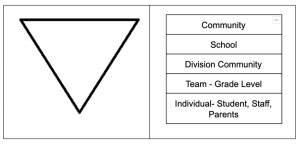

My hat is off to the schools that go full-on to provide wellness educational opportunities along with natural mechanisms to help all community stakeholders live and embed wellness into their lives.

Here is what I finally came up with for this post, including a graphic I put together a couple of years ago for the wellness committee at my current school.

Community Wellness

Community Wellness

How and where can school leaders help to diffuse the tenets of Positive Psychology (wellness) into the culture of the school and the greater community? I don’t have the background in administration or school communications to answer this question, but here are a few ideas. 🙂 A few areas that come to mind for broad integration opportunities are hiring practices, policies, ongoing staff professional growth, curriculum integration including planning templates and rubrics, communication conduits (i.e., newsletters, email, social networking), a wellness information resource site, a parent learning portal, etc. As for the question of where to spread the seeds of wellness, the answer is, of course, EVERYWHERE!

I think a good place for school leaders to start their planning is to look at how they approach the diffusion of the school mission and core values into the school culture and the greater community.

Schools naturally offer orientation and some sort of onboarding process for students, parents, and new staff to learn about the mission and culture of the school. I can see schools going BIG when it comes to introducing the school wellness program to newcomers as a part of an ongoing orientation program.

Parents could be offered a series of workshops on the mission and wellness practices and a wide array of topics/needs gathered from previous new parents’ reports. Sticking with wellness, book clubs, parent meet-ups, and online resources via a parent portal could also be shared as part of the diffusion process.

The Strength Switch, based on Positive Psychology, is the book that we are using at my school for a parent book club. I could see going big by giving all the new parents a copy and the opportunity to join either workshops on strength-based parenting or book clubs while providing online guidance via the parent portal on applying the principles shared in the book.

A theme of my blog posts about supporting parents is that schools should offer pathways for face-to-face (F2F) and virtual learning in the languages of the parent community.

Potential wellness workshops and online resources could be offered F2F and online on the topics of:

Another area to embed wellness practices and language into school culture is co-curricular activities and weekend community events. There are many natural ways to bring PERMAH and character strengths into the learning process, from sports to afterschool classes to the arts. Here is a blog post where I wrote about after-school programming and wellness.

Don’t limit your thinking to only students participating in afterschool activities. Look for a parent center with staffing and resources to support learning on the topics listed above and the others your community needs assessment results give you to provide to your school leaders.

As for staff learning about wellness, think outside the box of the typical “sit and get” sessions of bringing outside providers. Go to tried and true professional learning methods like Teachers Teaching Teachers (TTT). Construct your menu of learning choices by leveraging the expertise of your staff! Team up your instructional coaches and wellness coaches to provide individualized and team services to help staff set up their Personal Learning Networks (PLN) to personalize their learning for personal and professional growth. Provide “afterschool activities” for staff, offering wellness activities such as yoga, Tai Chi, meditation, local cuisine cooking, art/music/drama, sporting activities, etc. (Thanks, Kattina, for the idea!) And look to provide a wellness podcast and a blog to provide ongoing and just-in-time learning opportunities. I guess you could also have a school wellness Twitter account that informs the community of blog and podcast releases.

The bottom line is to find ways through multiple pathways to support the wellness of your community members!

Photo by Chaozzy Lin on Unsplash

Family Wellness Progress Reports

A portion of my work as a counselor is doing some form of intervention in family systems. The continuum from parents needing just a few strategies to the extreme of working with families to get into therapy makes individualization for each family very important. But there are some givens that parenting experts agree upon that work for all families, whether it be in setting up routines, opening up communication, disengaging from technology, etc.

As a counselor, I know that offering strategies while guiding parents to read parenting books and websites is only the first step in supporting students and their family systems. Following up after parent meetings is essential to check in and continue the dialogue. It is also essential to provide and coach parents in using structures to help improve family dynamics and from a wellness angle to help families thrive.

One of the main structures that I offer families is to have regular family meetings and work together to put plans together. I wrote about this in the spring with the post An Opportunity for Making Plans!. I outlined steps to follow to construct family wellness, tech & media (digital wellness) use, and mission statements. And, of course, individual family members can create their own personal versions of the plans.

I tried to build practical action steps for the plans to make them tangible and a part of family cultures. One additional strategy is to have families design wellness progress reports to support each plan’s implementation and ongoing follow-through. Schools use the term progress report to mean different things. Still, in this instance, I offered it as a formative assessment to support reflection, communication, learning, and other goal-setting while celebrating progress.

When you add the character strength of proactivity by making family meeting appointments in the family calendar, families have a real opportunity to further live their mission, wellness, and digital wellness plans.

Image Source

Wellness Assessment

Here are a few ideas to think about when it comes to assessing the wellness of your students:

  • Rubrics: Work with your students to design a rubric for each strength and PERMAH pillar at an age-appropriate level. The rubric creator, Rubistar, can help with this process. Here is a sample rubric for grit written for high school students.

  • Survey: The Institute of Positive Education provides a survey to measure students with their PERMAH and Character Strengths. It is for students ages 8-18.

  • Visible Thinking: Harvard’s Project Zero researchers provide thinking routines and other approaches to help students make their thinking visible. Several strategies have students sketchnoting, mind mapping, journaling, etc., to make their thinking visible for reflection and assessment purposes. Several thinking routines were listed here under the PRIME and SECONDARY strategies.

And there is a growing market of commercially offered wellness assessment tools.

Image Source

Collaboration to Improve PRIME Wellness Integration Strategies

Suppose you have visited my Wellness@ES resource site to review the integration strategies for each character strength. In that case, you will see that I list the main ones as PRIME integration strategies and secondary integration strategies for each strength. The Prime strategies should work to integrate all the strengths and have a decent chance of deepening student understanding of the Character Strengths. Here is the Kindness Strength page as an example in which you can scroll down to see the Secondary Strategies.

It looks like we will move forward in the teaching phase of the wellness program at my school. Our teachers naturally put in a lot of time to help their students with their social and emotional growth. I think the next step is getting further teacher buy-in and input on the strategies. While there is 100% buy-in for teaching wellness, it will be essential to give our “wellness chefs” the opportunity to work from their own recipes as they craft their wellness integration lessons.

I plan to start our wellness integration program using the following template if permission is given to try it.

Step 1 – I prepare handouts for each PRIME integration strategy using the template pictured above, listing the strategy in the center of the document.

Step 2 – I work with the grade level teams, including the specialists, to set aside time in one of their planning meetings to collaborate to improve the strategies.

Step 3 – I prepare and print out a poster-size version of the above-listed template with one strategy per document. I wrangle up some Post-It notes.

Step 4 – An administrator and I meet with each teaching team to review the template worksheet. Team members first work individually to write responses to the questions using individual Post-Its to stick to the large-size PRIME strategy worksheets.

Step 5 – We then review each other’s work on a couple of the character strength worksheets. We look to synthesize what comes to mind from our discussion as we go through the Post-It notes. We finalize our responses to each template as I take notes.

Step 7 – I work with the team leaders to set follow-up meetings to review the remaining character strength worksheets.

Step 8 – I compile the final responses to edit and improve the PRIME strategies listed on the Wellness@ES site.

My next post will be about moving all this creativity and ideation into action.


Photo by Charles Deluvio on Unsplash

Wellness: The Umbrella Construct

A Captain Obvious moment here. As we try to package and “sell” our programs to a busy clientele, in this case, teachers and parents, it only makes sense to demonstrate how the program has interrelated purposes that meet multiple learning needs for our students. Thus, when we talk about wellness, we are talking about its umbrella nature of combining under PERMAH several very everyday initiatives that are found in our schools.
The three everyday efforts that come to mind as part of the process of supporting the whole child are social/emotional, (digital) citizenship, and health learning. These are pretty standard areas of concern for schools. However, I wonder how many schools communicate to stakeholders just how interconnected they are.

Let’s start with health which connects directly with the H in PERMAH. There is straightforward physical health. Then there is of course mental health which connects to what we now call “digital health” which also connects to emotional and social regulation which connects to the Positive Emotions and Relationships in PERMAH. Whew, I need to take a connections break. That is a lot of connectivity!

A big part of working to increase one’s well-being and hopefully flourish is to use PERMAH and the character strengths to self-reflect to then take action steps where we need to grow within the PERMAH pillars by engaging various strengths. The process of self-reflection and increased self-understanding connects to the social and emotional regulation that are foundational elements of CASEL’s listing of social and emotional learning (SEL) competencies. The character strengths of kindness, love, self-regulation, and social intelligence directly support the SEL competencies.

Personalized Student Planner to Support Learning and Wellness

Source

I have previously written about various learning delivery systems (LMSs, portfolios, blogs, WebQuests, etc.). Today, as I wrap my brain around how we will eventually weave our wellness program into the curriculum and fabric of my school, another delivery system comes to mind- the student planner.

As I have not been a classroom teacher for quite some time, I am unfamiliar with what present-day student planners look like and how schools use them beyond the conventional use of writing down assignments.

I searched for digital examples of planners but did not find much more than calendars with to-do lists and some goal-setting sections. When I searched for images, I came up with more. For example, the following image captures my ideas of embedding study skills into the planner.


Source

The photo below gives another idea of helping students with their self-understanding. The inclusion of learning instruments infers the idea of students having a learning toolkit that connects to my Personal Learning System(PLS) blog posts and the PLS section of Web Resources for Learning.

Source


I don’t want to embarrass myself too much with my lack of knowledge around planners with you, the reader, saying, “David, your ideas have been in use for 20 years!”. Thus, I will offer a few broad ideas, followed by further research on how schools support learning with student planners. I would love to have readers use the comment tool to post how their schools use planners beyond calendars, to-do lists, and homework recordings. 🙂

So my big, and I am sure the old idea, is to put on a designer cap to use the planner to support learning school-wide or divisional initiatives and programs. Examples are the school mission and values, life skills (i.e., wellness, SEL, Habits of Mind, etc.), study skills, Information and Communication Literacies (ICL), field trip support, etc. With many schools providing student portfolios, one may leave the traditional curriculum scaffolding to the portfolios and the LMS. This could provide the usual structure of question prompts for learning reflection, learning goals, resource links, whole units as learning modules, WebQuests, etc.

A second big and probably not doable idea would be to make the planners personal- to give students some choice in the design and content. Form a design team to outline the sections of the planner with clear connections to the initiatives, programs, themes, skills, etc., that the staff wants to promote. The next step would be to differentiate by giving students a choice over design features such as color, theme, layout, and other format aspects. The customization continues around the themes, skills, etc., where students can have their interests (talk about personalized learning!) and guide them through adding more content pages on topics that interest them in their learning. 

An example could be the Character Lab strengths and overall wellness, with students having a basic FYI for each strength with a choice to add more in-depth content with more pages. Health outside of school, regarding diet, sleep, getting outdoors, physical activities, etc., would be high on my list to help students build routines and healthy habits. There also could be a planner section dedicated to learning outside of school with listings on how to volunteer, apply for a job, design family outings, etc.

I have been working with a high school student to design a wellness app with modules for PERMAH, Character Strengths, goal-setting, etc. You will need to differentiate between your wellness app and the wellness aspect of your planner if your school does both. 🙂

Yes, one reason for the improbability of this endeavor is the time, knowledge, and money it would take. This is where I wonder if any companies make student planners who are already or thinking about going into the growing personalization market. If you can go online to customize your sneakers, a company can work with a school to create a website with the desired format and content choices for students to log into and design their planners. This sort of gets at my idea of teachers hiring an “information broker” to gather content, lesson ideas, and resources to design their units of study.

The education market can be lucrative, with companies like SeeSaw for portfolios and SchoolBuddy for afterschool activity management finding their niches. So there may be companies out there moving into the personal planner market. Adding to the customization would be offering both a paper and app version of the planner for further individualization.

Learning Opportunities for All Community Members (Student Support Services & Parent Portal)

The full title for the post is “wellness, parenting, academic learning skills, life skills, learning for all community stakeholders through a variety of conduits and modalities” via student support services and a parent portal. 🙂

The parent portal would be presented to help parents expand their parenting toolkit with a listing of parenting topics, including wellness supported by articles, books, podcasts, videos, parent workshop slideshows, online courses, etc., including a section on parenting in the digital age.

The student support portal for teachers would have a section containing a Web Resources for Learning style toolkit for instruction, assessment, character development, etc., resources. And, of course, there would be a student section with learning resources that could include ways to help students construct their Personal Learning System (PLS).

The roadblock for the parenting section in international schools is language. One way to work through this barrier would be to engage PTA volunteers and high school students interested in service learning. The PTA could form a committee to research parenting resources in the languages of the different parent populations. They also could provide translation services for the portal pages of information as authored by the school counselors and other providers.

High school students can do the same sort of research and translation. It is especially the case in International Baccalaureate (IB) schools with diploma-candidate students needing to do creativity, activity, and service (CAS) hours.

Image Source

© 2026 Lessons Learned

Theme by Anders NorenUp ↑

Skip to toolbar