Lessons Learned

Instructional Technology - International Education - Wellness

Category: Personal Learning System (PLS) (page 1 of 3)

Shifting from PD to Personalized Learning

This past week I listened to Dan Taylor and John Mikton’s  The International Schools Podcast, in which John interviewed my old podcasting partner Jeff Utecht and his current podcasting partner Tricia Friedman. Listen to the episode as they cover various interesting issues, including professional development (PD). Jeff and Tricia are consultants and PD providers, so they shared many helpful insights on this topic.

What caught my attention was when Jeff noted that we need to move away from the term “professional” development and toward “personal learning.” His statement reminded me of our Ed Tech Co-Op podcast’s episode entitled “Personalizing PD” in 2015. Jeff and I discussed multiple pathways to support educators’ professional learning. Our big takeaway was, yes, build in a system for individualized and personalized learning not just around professional learning but also around personal non-job focused learning. It really was a good and helpful episode, if you ask me, so take a listen. What we said in 2015 is even more relevant today when the pandemic’s conventional practice of bringing in consultants for face-to-face learning is limited.

I wrote Jeff after listening to the podcast, saying that I have no idea where the field of professional development is today. Still, I had a couple brain-pops that might help educators think about their learning. First, we know the term “personalized learning” has been a buzzword for some years regarding student learning. I have covered this topic in my blog on a few occasions. I also developed a section on the Web Resources for Learning website dedicated to helping students design what I call their personal learning system. On that resource page, I mention that educators also develop their own personal learning systems. I think educators would see the connection when one says the term professional learning network or PLN.

Network means being connected to resources and others, while system means how to make the connections and on what topics. So as students might have subject area, information gathering, curation, etc., categories of their Personal Learning System, educators also do the same with their PLNs. An elementary teacher’s “system” might cover subject areas, instructional methods, assessment techniques, etc., along with the tools to reach out to resources and thought leaders while also sending the teacher’s ideas to others in the network. Many tools are social networking but can also include web resource sites, podcasts, blogs, and other information sources that can be curated.

Helping teachers see their learning as networked and part of a system might help them visualize whether they have a PLN or not; they might want to shift from thinking that their school is the leading provider of their professional learning. And as Jeff and I spoke about on the podcast, we need to move away from siloing our learning into professional versus personal. Many folks have their social networking and information resource providers mixing in professional and individual learning. I find that I get a lot of ideas around education by reading and listening to thought leaders who are not educators.

Another idea is to think about how you learn. We discuss how students learn, including which modalities might help support differentiation. We also talk a lot about student agency, including helping students better understand how they learn. So as is often the case, we can apply what we are doing with students to ourselves. 🙂 Look to enhance your agency by thinking about the variety of ways you learn as you look to develop or recalibrate your PLN. I am reminded of a blog post I wrote entitled “How Do Adults Learn?“. It might provide some insights as it was based on current research.

So if you have a PLN, you might have reached out to your instructional coaches, librarian, and possibly some other teachers, significantly those fluent with social networking tools, to help you build your network. If you don’t have a PLN and want to further personalize your learning, you might want to reach out to these folks for content and connection tools to get you started.

Speaking of Jeff, Tricia, John, and Dan, you really should look to follow them on Twitter and/or other networking tools where they are present to add them to your PLN.

Photo by Clint Adair on Unsplash


Study Plan Template

I wrote a few times about how the teachers in my elementary school provided scaffolding for students during virtual school. They organized the day with a set meeting and independent work times, provided templates, and built routines, among many other support strategies.

I need to ask them if they also provided a study plan template for their students. This topic came up in a book club on strength-based parenting that I am running with some parents. We were talking about helping their children engage the character strengths of self-control and proactivity while growing their self-confidence.

The web is filled with study plan templates, so going one step further to enhance student agency is to provide a template and let them personalize it. Students can draw their own study plans or search the web for examples. Here is a simple one that I put together that includes the idea of students recording their daily study routines.

This topic of students as designers of their learning connects to my posts and webpage on creating one’s Personal Learning System (PLS). A related topic is constructing an ICL Project Plan using technology for research and creating learning products.

Virtual School Pedagogy – Oldies but Goodies

Note: My international school is just starting virtual school for the current school year, so we are now just experiencing what many schools have been doing for most of the year. I posted the following to our Wellness blog.

I hung up my instructional technology hat a ways back, so I can’t offer the latest tools, tips, or techniques that many of our staff use in their virtual learning delivery. I can offer pedagogical strategies that have worked in the past and can definitely be supported through technology to enhance learning in virtual schools.

Concept/Mind Maps

Concept/Mind maps help students make their thinking visible, primarily when representing connections between ideas, events, topics, etc. Concept maps also can be used as collaboration tools.

An excellent way to use concept maps for virtual learning is to use an online provider like Mindmeister. Students can share their Mindmeister concept maps with you to access their thinking, especially for formative assessment of their understanding as the unit of study progresses. Virtual collaboration is supported if you partner with students or place them in groups to work together to use mind maps for multiple purposes. Here is a mind map template for essential questions one teacher provided his students. Look at a blog post describing how students used concept maps to answer the essential questions for their units of study at a couple schools.

Learning Activity Types via TPACK

Several American professors came together in 2010-11 to organize learning activity types (LAT) into nine subject areas supported by technology. They published articles about their efforts. Here is one. They provide research-supported pedagogies in their Learning Activity Types website hosted at the College of William & Mary School of Education. They apply the TPACK construct for planning purposes. Look to their website by going to the left side menu to select from the nine learning activity-type disciplines. The supporting technologies are from 2011, so adapt ones that still exist today and/or find the latest iteration or replacement tool that best supports each pedagogy. Image Source

Multimedia Essays (Media Mashups)

Writing essays is one of the most precious skills that we teach our students. But sometimes, our students can benefit from an alternative learning experience and assessment that engages the full range of their ICL skills. We can differentiate and add complexity to the standard writing process by having students create multimedia essays where they “mash up” various sources of media to communicate their thinking. At the time, a William and Mary doctoral student describes her work with multimedia essays in this podcast. Image Source

Personalized Learning System (PLS)

Students (and teachers) use technology to access information, to make meaning, to create and communicate their learning via a personalized set of resources for learning… a “go-to” 24/7 technology and information access toolkit – a Personal Learning System (PLS).

We guide our students to work as architects designing and maximizing their “learning flow” (think of the term workflow) while also engaging in time management techniques to increase efficiency and purposeful productivity. Self-directed and growth-minded students use devices, apps, Web tools, and information sources, putting themselves in charge of their learning. Here is a web resource describing what a Personal Learning System can look like and a planning document for students to work with. Image Source

Sketchnoting (Visual Note-Taking)

Our students live in a media-rich world. They think in images, video, and sound while constantly making neural connections. The creation apps on phones, tablets, and computers offer students pathways to draw, audio record, insert images/video, and embed hyperlinks to information sources, all personalized. This is where visual note-taking comes in. We can expand note-taking choices beyond text recording into multiple modalities by guiding students to use mind maps, colors, shapes, images, and digital grouping by dragging and dropping objects and connecting lines to record their thinking. Image Source

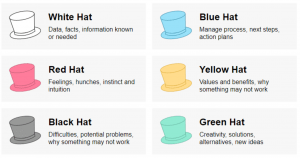
The Six Thinking Hats

Edward de Bono created this approach to decision-making and problem-solving that guides users to think in terms of types of thinking and perspective. We can apply them for individuals and groups of students to use as they process information. Here is a helpful overview and a teacher’s application in her classroom. Image Source

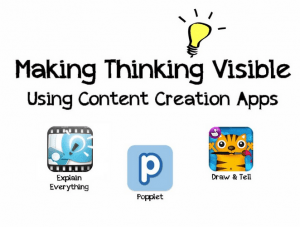
Thinking Routines

In the book Making Thinking Visible, Ron Ritchhart, Mark Church, and Karin Morisson help readers understand the power of thinking routines to help students process big ideas and make their thinking visible. Teachers routinely use the thinking routines in their regular face-to-face classes. One can also choose from a variety of technologies to also use in virtual school. Here is a dated web resource on the supportive tools one can use. However, the application of the routines is sound. If you are new to the routines, you can review an article by Ron Ritchhart and David Perkins entitled Making Thinking Visible. Also, look to go through the Harvard Project Zero Thinking Routine Toolbox. Image Source

WebQuests

WebQuests are a natural pedagogy for virtual schools because they’re already web-based. They connect inquiry and research skills to students working in teams using their communication skills to present their findings. WebQuests are online research expeditions built by teachers that put the students into roles to find information from selected sites and other resources as they attempt to solve a real problem and/or answer a question. The students in teams analyze, curate, and then use the information to create a learning product to demonstrate their understanding. WebQuests are NOT internet scavenger hunts with students just going through a list of links. True WebQuests have the students performing in the authentic roles of historians, economists, mathematicians, etc. The culminating project is usually a performance task in which the students present their findings while playing their roles or applying the learning to produce a product. Image Source

___________________________________

A significant wellness connection for these pedagogies is that they engage students in PERMAH while exercising their Character Strengths. Collaboration amplifies Relationships with students using their strengths of kindness, leadership, and teamwork, to name just a few character strength applications. The process of creating definitely has students applying their strength of creativity within the pillars of Engagement and Accomplishment.

So how do we take these oldies but goody strategies and other current innovative and effective practices to spread them throughout our virtual school? One approach would be to form a virtual school design team in each division who become busy bees finding out what’s happening in virtual classrooms elaborating on ideas, and making connections to new approaches. They then cross-pollinate throughout the division and potentially between divisions. 😁

Album Cover Image Source

The Game of School – Steve Hargadon

Steve Hargadon recently posted The Game of School to his blog. I suspect that it caught the attention of many educators as Steve is a true thought leader in the field of education. If his name is new to you, do look to subscribe to his blog and read up on the many ways he influences teaching and learning around the world. Steve is definitely one to take action on his ideas. Look to read through his follow-up post about his online classes for students, teachers, and parents.

My main takeaway from Steve’s posts, from my perspective as an elementary school counselor and instructional technologist, is for me to continue to build on the ideas and strategies that I have written about the last couple of years around re-imagining the role of school counselor while connecting to (digital) citizenship, wellness and personalized learning for all stakeholders. Working backward from Steve’s high school-focused outcomes, what can be done in the elementary to either lay the foundation for or possibly alleviate the need for some of Steve’s high school-oriented points?

In other words, wouldn’t it be better to help parents and students construct their parenting and learning toolkits by the start of Middle School? Of course, this is the case and I am sure Steve has coursework for parents of elementary students.  And of course, wouldn’t it be something for more schools to stop playing the game of school!


Image Source

How Might An Educational Services Company (ESC) Support International Schools?

What advice would you give an educational services company (ESC) that wants to break into the international school market? When I lived in the U.S., I consulted with a few providers who offered after-school activity programs, so my experience was minimal. But I can put on my instructional technology hat to think as a designer looking at challenges and opportunities to develop some plans moving forward.

I am reminded that the first step to supporting clients in determining their needs. My son Sam adds to this point that the ESC should not look at the client’s needs only within the scope of the services that they can provide. They should be ready to say, “we don’t have the know-how to help you with difficulty, but we can help find someone who does.”

With international schools, it is essential to focus on their mission and values at the center of one’s services. We need to recognize that schools, in general, are conventional places, so starting to make things run better comes first, followed then by helping school leaders feel comfortable with new ideas.

Even progressive-minded parents who want their children to develop their thinking skills want the same experience they had as students. I remember a talk that Daniel Pink gave our staff at one of my schools. He said to be very careful in using words such as “innovative or cutting edge” in describing new programs.

The elephant in the room for some international schools is that their students are so managed and over-scheduled outside of school. Some students miss out on the typical developmental learning opportunities of unstructured play and making independent choices. Having free time and opportunities to become more independent is a problem that some schools are taking on through parent education outreach. I am guessing that the ESC could combine Outward Bound style activities with unstructured times giving students more “real life” experiences. It is a subject that an ESC should seek to learn more about.

__________________________

My approach here is to list needs and support strategies for the stakeholder populations of international schools. As stated previously, the first step is determining the stakeholders’ needs to design the programs to meet the needs. The needs will vary depending on factors such as what programs are already offered, locality and school culture (i.e., school mission), and school leadership mindset (i.e., static “That Is The Way We Have Always Done It” vs. a growth and openness to possibilities mindset). The themes of personalization, coaching, and accessibility, as well as self-discovery and personal growth, run through the strategies and constructs.

The following are ideas that I have written or podcasted about that could be developed by an ESC to offer services to their clients. The following strategies and program offerings cut across, in several cases, the student, staff, and parent stakeholder populations.

Resource Websites/Portals: Challenge> Students, teachers, and parents need access to valid information to support their roles as learners, teachers, and parents. Students- Libraries often provide a good listing of databases for general research but too often, students turn to search engines for their schoolwork. Teachers- Many teachers prepare learning modules posted in their school Learning Management System (LMS), so they often look for new resources. Parents- Some international schools have some form or other of a parenting resources web page, but they might still need a consultation to improve them. Another needed resource list for parents is orientation support for the school, community, and country.

ESC Services>

Students- Work with interested staff to build out the current LMS information resources portal for skill and subject-specific content or develop a particular resource website, if needed. An ESC can draw from many web resource sites to connect to the teaching and learning needs of their client schools. My Web Resources for Learning is an example site I did not create for one specific school, so it is a bit general, and some of the links need updating.

Teachers- My Web Resources site has a teacher section that can be used as an example. Connecting to personalization, teachers need specific books, videos, instructional strategies, web resources, etc., to improve their day-to-day teaching and units of study. The ESC either has resource finders on staff or hires independent contractors (think Etsy model). I wrote about this in my Information Brokers blog post.

Parents- Parents don’t always have access to parenting books in their native language, so they need valid information on parenting and other topics such as orientation to a new school and country, school calendars, events, parent workshops, etc. Parents also can be supported by helping them connect.

In the early 2000s, Justin Hardman designed and built a multi-faceted community sharing and learning portal for Hong Kong International School (HKIS). It was called myDragonNet. You can read the article we wrote about to give you an idea of what Justin created. Justin was way ahead of his time with the myDragonNet Learning Management System (LMS) because it provided space in the portal for parents and the greater community to connect. It had a social networking feel, as groups could set up mini-portal within the system. I would like to know whether or not current commercial LMS providers offer modules for community members. So I can see an ESC working with the current LMS to adapt functionality or build a separate portal for parents and community groups. Helping schools design and construct a parent portal would be high on my list of services offered. An added component would be to offer face-to-face and online courses for parents to help them construct their parenting toolkit.

Personal Learning Plan: Challenge> We want our students to be engaged and to take ownership of their learning. However, as students progress through the school divisions, they sometimes become passive and reactive to the high stakes programs like A.P. and I.B. They learn to play the game of school. Thus, how can we give students more agency, engagement, and control over their learning?

In the U.S., students who have documented special needs by law must have an Individualized Education Program (IEP). I have heard of some schools with leaders who realized that all students could benefit from personalized learning plans, creating them for all students.

Teachers- See Personal Teaching System response below, as teachers can benefit from having a professional learning plan to improve their Teaching System. Too often, schools bring in consultant P.D. providers who offer a one-size, sit-and-get delivery experience. Just like their students, teachers deserve a differentiated approach that hopefully involves some individualization.

Parents- The often-used line is that parents don’t receive a how-to parenting manual with the birth of their children. Fortunately, we have many authors and websites that can help us create our parenting toolkit.

ESC Services>

Students- I need help seeing the ESC coming in to help design learning plans for all students for several reasons. But I can see them consulting and coaching, providing a template and menus with learning strategies to draw from. The students should be at the center of the learning plan design process, working with their teachers and parents as coaches to design and follow through on their plans. Each student should have a learning plan as part of their portfolio.

Here are a couple of related blog posts.

Parents- One of the first steps parents can take in designing how they will raise their children is to construct a family mission statement. I can see the ESC providing face-to-face and virtual workshops to give parents the blueprint to work with their children to create their family mission statement. Over time we bring our children into the mission statement development process to redesign our statements with the byproduct of helping orient them to understanding one’s values and how to act with them in mind.

Personal Teaching System: Challenge> Many international schools provide their teachers with ongoing professional learning opportunities. This doesn’t sound like a problem. The difficulty can be with teachers who feel overwhelmed with instructional strategies, assessment techniques, etc. In reality, good teachers develop their personal “teaching toolkit” to design and deliver learning experiences for their students. Teachers choose from approaches such as Project-based, Problem-based, and Inquiry while creating activities that help differentiate the content, process, and products for flexible grouping of students. Fortunate young teachers have mentors and Personal Learning Communities (PLC) in their schools and Professional Learning Networks (PLN) that also help grow their teaching system.

ESC Services>

Teachers- I wrote about this topic in a blog post where I noted a place for consultancy companies to be like an information broker but for finding thought leaders and practitioners for teachers to follow via Twitter, blogs, podcasts, and other conduits to improve their teaching. An ESC could provide mentoring and coaching in person and virtually, starting a network of retired teachers interested in coaching teachers new to the profession. As mentioned earlier, I don’t think bringing in consultants to deliver a one size fits all P.D. experience is as effective as guiding teachers to personalize their P.D. by giving them a menu of podcasters, bloggers, authors, and other experts to include in their Personal and Professional Learning Network (PLN). When you add in the process of being coached to develop a learning plan with goals and activities, our teachers take ownership of their P.D. which then has more follow-through in the classroom. Here is our Edtech Co-Op podcast show on the topic of personalizing P.D.

Personal Life Plan: Challenge> Children and adults face an information-overloaded world with ever-increasing expectations for performance in school and at work. This leads to growing anxiety levels and declining well-being in our populations. Students and Teachers- The overlapping with Personal Learning Plan and having a Life Plan seems obvious. We don’t just plan for and learn at school. We learn for life, so a pathway forward is helpful.

ESC Services>

Students- As with the Personal Learning Plan, the ESC would work as consults and coaches to help schools design and implement this program. The Personal Life Plan would encompass the whole child with sections dedicated to life skills, character development, wellness to include physical and mental well-being, etc. In other words, please look at the Positive Education model’s six pillars and supporting character strengths in designing the plan template for your students. A possible helpful connection would be to design a process for students to create their mission statements with the learning plan providing actionable strategies to living the mission statement values.

This is where the coaching services come into play. I can see an ESC, especially in M.S. and H.S., providing one-to-one life coaching services for students. In the Elementary School, the ESC consultants could partner with the school counselor (life coach) and the teachers to develop a robust wellness program. Looking at the student’s physical, intellectual, emotional, and social needs, the students could use several learning systems (e.g., portfolio, personal planner) along with goal-setting to map out their plan to be well and to thrive. Here are a few blog posts on wellness and the counselor as a life coach.

Teachers- I can see the ESC providing life coaches to help teachers design and implement individual wellness plans, including writing individual and family mission statements.

Personal Learning System: Challenge> Back to the stressful and information-overloaded world we live in, students, teachers, and parents can benefit from a framework that harnesses technology and learning hacks to support their learning.

ESC Services>

Students, Teachers, and Parents- With technology being so intrusive into our lives and, at times, managing us, I think an ESC could work with instructional coaches and teachers to help students manage the technology to support and enrich their learning. I write a lot about this on the Personal Learning System page of  Web Resources for Learning. I can see the ESC offering workshops for teachers and parents and coaching services to help them find the apps, websites, and other resources to be more efficient and productive and hopefully more “digitally” well in their lives. The ESC could offer online courses at the parent portal not just for developing a learning system but also for other needs as requested by the parents.

There is an overlap with technology in life planning, life coaching, and the personal learning system. The focus is using technology to enhance lives which means developing a technology/media use plan that supports balanced living and well-being.

The themes of personalization, coaching, and providing web-based resources run through these programs in some form or another. Schools have been working on “personalized learning” for some time, primarily as it supports individualization and differentiation while also connecting to inquiry and student agency. Teachers and instructional coaches work as designers who coach students to own and guide much of their learning. It is similar in the adult world with life coaches.

While living outside Washington, DC, I spoke to many driven, on-top-of-their-game people. I noticed that several of them had a personal chef, a financial coach, a fitness coach, a life coach, etc. My experience with international communities is similar in that I meet many very driven people. Sometimes people who are busy and have the funds want to be as efficient and productive in covering their needs as possible while working towards actualization with their personal growth. Coaching brings expertise into their lives. It is an excellent opportunity for educational services companies. Thus, international schools should see how they might adapt to provide the coaching model in how they support their stakeholders. 

Offer Afterschool Activities (ASA)- 

While this post aims at what an ESC can offer international schools, it is also the case that schools can go in-house, hire co-coordinators and build their programs as in after-school programs. This is what schools do. Hopefully, these ideas, especially on ASAs, make sense for school leaders as I believe that ASAs offer a massive opportunity for international schools further to meet the learning needs of their students and parents while supporting the school’s mission.

My first advice to an ESC with after-school activities is to see what some of the big dogs of Asian international schools are offering. This doesn’t mean you are going to find groundbreaking approaches. I see a massive opportunity to bring fresh eyes and some unconventional thinking to view how international schools do after-school activities. A couple of starting points in rethinking after-school programs would be looking at the student’s needs and interests and the school’s mission. We then work backward as designers to develop an overall plan while simultaneously piloting some classes to gather data in developing our blueprint. Here is what I found for Hong Kong International School.

Thinking beyond elementary school, an ESC can also look to Middle and High schools to offer skill-based after-school enrichment and mentoring for student-led clubs. Here is a listing at the Shanghai American School offering 100+ clubs for their students. While many of those clubs are student-initiated and student-managed, as they should be, I see lower-level international schools needing consultation and coaching to offer clubs connected to the school’s mission and student interest. They also, at times, will need outside expertise for mentoring clubs, especially ones looking for community outreach and real-life experiences. And something tells me that some schools need athletic coaches as well.

I could see when developmentally applicable to offer “junior versions” of M.S. clubs, as David Perkins says of activities that work for older students and can be redesigned for younger students.

One challenge for elementary schools is asking teachers, after long days of teaching to offer after-school classes. I am still determining where the big schools are in making teachers teach after-school classes, but I do remember seeing lots of outside contractors coming into the Upper Primary at the end of each day when I was at HKIS. I have a few ideas listed below that can take after-school teaching classes off our teachers’ plates.

When I consulted a couple of years ago with an ESC specializing in after-school classes, we spoke about developing and documenting their curriculum so that new teachers could walk in and access the web-hosted lessons. Of course, this only applied to some classes like instrumental music or upper-level painting, but it could work for most lighter content offerings. This also meant that the Educational Services Company was independent of their teachers’ individual interests and talents.

With the curriculum ready for new teachers, I can see international schools supporting their teaching assistants to teach the after-school classes to earn extra pay. Here is an example of a web-hosted class that I started that could be taught by someone other than myself.

One category of offerings could be to offer classes to prepare teams for international enrichment competitions such as Future Problem SolversOdyssey of the Mind, etc. One can offer standalone classes built around themes such as peace and reconciliation (i.e., The World Peace Game, speaking and presentation skills (i.e., perhaps a student version of Toastmasters that includes ICL presentation literacies, etc.), and of course, all the possibilities that come with STEAM. There are also a lot of individual competitions that mentoring could support students to compete in.

A second idea that the owner of the ECS and I spoke about was to offer a series of classes in a discipline in that students would earn badges toward certification. Here is an example of what I called The Digital Scholars Program, which covers study skills, (digital) citizenship, and some digital literacy skills. Another example could be certification in wellness following the PERMAH model, including the “H” for health and the Positive Education approach to strengths education.

The third idea is that once the classes are created and taught face to face, then think about offering them in a blended fashion and possibly later in virtual form for students outside one’s international school. This takes me back to a meeting a long time ago at HKIS when the instructional technologists were meeting and talking about possibilities. We had come off the successful running of virtual school during SARS. We noted that the HKIS brand was solid and worth expanding. This led us to think about how the school might start offering online courses for students outside of HKIS.

The fourth idea is to work with one’s PTA and counseling staff to design and teach classes for parents. Helping busy parents expand their parenting toolkit already happens in many international schools, with counselors teaching parent workshops and PTAs bringing in guest speakers. The next step is a needs assessment to design a curriculum for the workshops. Whether they are offered during regular school hours or after school is okay, but marketing them as adult ASAs is another way to connect with parents. And just as for the students, it would be a bonus to offer them in blended and virtual fashion for parents who cannot attend face-to-face classes. And who knows, the ESC offers more leisure-oriented classes such as cooking, fitness, etc. This connects to the life coaching and wellness theme mentioned earlier. Check out my blog post on creating a parent portal for more information on this topic.

And then there are “academies.” Academies are where some overworked and over-managed international students go at the end of the school day to study languages, math, test prep, etc. Students start attending academies early in elementary school and continue through high school. I wonder if this situation occurs in international schools worldwide, but it is prevalent in Asia.

I won’t get into the politics and parenting of sending students to academies. Still, I would like to know what they would look like if offered on the international school campus. The optics might be wrong, especially with schools that try to get families to let their children go home after school to play and rest before they do their homework. I wonder if school-based academies offer school leaders opportunities to improve the content and delivery while working with families to think about decreasing the time their children spend in classes. Academies could be a place for supporting all the personalized support strategies listed in this post, including tutoring. Coaches at the academy could facilitate skill-building in their students across several life categories, including character strengths, wellness, and communication skills, to name a few possibilities.

This is an area where the ESC could advise and run the academies for the school, making sure to connect to the school’s mission and values.

One of the providers I worked with in the U.S. ran summer camps at schools and parks all around the Washington, DC, area. I can see an ESC doing the same for their international client schools, not just in the summer but also during the long winter break for families that are not traveling.

Offer Blended to Virtual Delivery Support

Blended learning is becoming more and more the norm in schools with the growth of Learning Management Systems with less time spent in class providing direct instruction. Many international schools have the personnel and systems to support blended learning. But something tells me that some schools have the tech infrastructure, but they need guidance to leverage it to deliver the opportunities that blended learning can provide. Educational services companies could provide the needed expertise in this area.

One big lesson that we learned at HKIS was that providing blended learning is the first step towards being equipped to handle a school crisis that leads to school closure. I see an ESC providing schools the know-how to fully develop their crisis plan and prepare the school to go virtual in case of closure.

Offer Administration Support

I am listing this stakeholder group because they have so much to do in their jobs, especially around planning, accreditation, local regulations, budgets, etc. With so much to do operationally, some schools might need the expertise and outsourcing that educational services companies can provide to support new initiatives and program management. Here are a few examples of standard programs and processes that some schools might need support to manage.

  • professional learning opportunities for staff
  • curriculum development and mapping
  • school crisis management plan development and implementation
  • policy and procedure documentation
  • change management

School leaders already naturally turn to the world of consultants. Educational services companies are consultants, yes, but there are not many who offer a wide array of expertise. I would like to know if enterprising ESCs offer a broker service giving their school clients menus of specialized consultant options with their backgrounds, costs, etc., to help decide who to hire.

In Conclusion-

I enjoy reading business articles and books. I especially enjoy listening to podcasts with interviews of thought leaders. Something tells me that educational service companies led by business and education minds offer their client schools attractive opportunities to support all their stakeholder populations.

Image Source

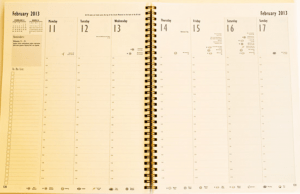
Personalized Student Planner to Support Learning and Wellness

Source

I have previously written about various learning delivery systems (LMSs, portfolios, blogs, WebQuests, etc.). Today, as I wrap my brain around how we will eventually weave our wellness program into the curriculum and fabric of my school, another delivery system comes to mind- the student planner.

As I have not been a classroom teacher for quite some time, I am unfamiliar with what present-day student planners look like and how schools use them beyond the conventional use of writing down assignments.

I searched for digital examples of planners but did not find much more than calendars with to-do lists and some goal-setting sections. When I searched for images, I came up with more. For example, the following image captures my ideas of embedding study skills into the planner.


Source

The photo below gives another idea of helping students with their self-understanding. The inclusion of learning instruments infers the idea of students having a learning toolkit that connects to my Personal Learning System(PLS) blog posts and the PLS section of Web Resources for Learning.

Source


I don’t want to embarrass myself too much with my lack of knowledge around planners with you, the reader, saying, “David, your ideas have been in use for 20 years!”. Thus, I will offer a few broad ideas, followed by further research on how schools support learning with student planners. I would love to have readers use the comment tool to post how their schools use planners beyond calendars, to-do lists, and homework recordings. 🙂

So my big, and I am sure the old idea, is to put on a designer cap to use the planner to support learning school-wide or divisional initiatives and programs. Examples are the school mission and values, life skills (i.e., wellness, SEL, Habits of Mind, etc.), study skills, Information and Communication Literacies (ICL), field trip support, etc. With many schools providing student portfolios, one may leave the traditional curriculum scaffolding to the portfolios and the LMS. This could provide the usual structure of question prompts for learning reflection, learning goals, resource links, whole units as learning modules, WebQuests, etc.

A second big and probably not doable idea would be to make the planners personal- to give students some choice in the design and content. Form a design team to outline the sections of the planner with clear connections to the initiatives, programs, themes, skills, etc., that the staff wants to promote. The next step would be to differentiate by giving students a choice over design features such as color, theme, layout, and other format aspects. The customization continues around the themes, skills, etc., where students can have their interests (talk about personalized learning!) and guide them through adding more content pages on topics that interest them in their learning. 

An example could be the Character Lab strengths and overall wellness, with students having a basic FYI for each strength with a choice to add more in-depth content with more pages. Health outside of school, regarding diet, sleep, getting outdoors, physical activities, etc., would be high on my list to help students build routines and healthy habits. There also could be a planner section dedicated to learning outside of school with listings on how to volunteer, apply for a job, design family outings, etc.

I have been working with a high school student to design a wellness app with modules for PERMAH, Character Strengths, goal-setting, etc. You will need to differentiate between your wellness app and the wellness aspect of your planner if your school does both. 🙂

Yes, one reason for the improbability of this endeavor is the time, knowledge, and money it would take. This is where I wonder if any companies make student planners who are already or thinking about going into the growing personalization market. If you can go online to customize your sneakers, a company can work with a school to create a website with the desired format and content choices for students to log into and design their planners. This sort of gets at my idea of teachers hiring an “information broker” to gather content, lesson ideas, and resources to design their units of study.

The education market can be lucrative, with companies like SeeSaw for portfolios and SchoolBuddy for afterschool activity management finding their niches. So there may be companies out there moving into the personal planner market. Adding to the customization would be offering both a paper and app version of the planner for further individualization.

Learning Opportunities for All Community Members (Student Support Services & Parent Portal)

The full title for the post is “wellness, parenting, academic learning skills, life skills, learning for all community stakeholders through a variety of conduits and modalities” via student support services and a parent portal. 🙂

The parent portal would be presented to help parents expand their parenting toolkit with a listing of parenting topics, including wellness supported by articles, books, podcasts, videos, parent workshop slideshows, online courses, etc., including a section on parenting in the digital age.

The student support portal for teachers would have a section containing a Web Resources for Learning style toolkit for instruction, assessment, character development, etc., resources. And, of course, there would be a student section with learning resources that could include ways to help students construct their Personal Learning System (PLS).

The roadblock for the parenting section in international schools is language. One way to work through this barrier would be to engage PTA volunteers and high school students interested in service learning. The PTA could form a committee to research parenting resources in the languages of the different parent populations. They also could provide translation services for the portal pages of information as authored by the school counselors and other providers.

High school students can do the same sort of research and translation. It is especially the case in International Baccalaureate (IB) schools with diploma-candidate students needing to do creativity, activity, and service (CAS) hours.

Image Source

Personal Learning Coaching and School Consultancy Services

So my eldest son works for Gartner, which is a leading consultancy and information provider for the IT world. They offer a subscription service that includes articles, their analysis, other resources, and conferences that bring the top IT companies together. They “cut through the noise with one-to-one guidance for the issues and opportunities that matter most.” Such a service made me wonder what it would be like if individual teachers and schools had their Gartner-style consultants to cut through the information overload to provide the best and most needed information.

I bring this topic up because I have noticed the incredible growth in podcast offerings which connects to the information overload many of us experience. Whether it be Slate, NPR, or another news organization, one can only get through a podcast with an advertisement for a new podcast. We are seeing the same thing happening in the world of educational consultants and conference providers. It is overwhelming. 

We are genuinely benefiting from a wonderful time of many providers offering us their expertise on topics from PBL to character development to personalized learning. So many go-for-it educators hang their digital storefront signs to share their expertise via Twitter, podcasts, blogs, etc. The breadth and depth of choices especially dealing with technology, is a lot different than 15 years ago when we had David Warlick, Jamie McKenzie, Will Richardson, and a handful of other educational thought leaders and presenters and ISTE’s Learning and Leading with Technology magazine. The choices were excellent but fewer in number, for sure.

With so many choices today, how do we help our teachers build their Personal Learning Networks (PLN) with a reasonable number of folks to follow and information resources that best meet their needs? I used to work with teachers to choose a podcast or two and a few blogs and sometimes confer about a conference to attend, but those were the days when the number of choices was manageable. It was an informal process but individualized to some extent. Looking now at the ISTE coaching standards, there is a section about expanding opportunities for online professional learning. This makes a lot of sense, yet I wonder how far tech-innovation-learning coaches will work from the needs of individual teachers to help design personalized learning systems (PLS) with their teachers and administrators. Everyone is so busy with so many tasks in front of them. Help is needed!

As I wrote about the need for an information broker system to provide teachers with digital resources to construct digital textbooks and online learning modules, I’d like to know if consultants offer a similar service for teacher professional (and personal) learning needs. It would be a massive task for a consultant or company to research professional learning resources to categorize and rate them within a database. Curriki does this to some extent, so there must be others.

Just think of all the “places” where we can find information to help us learn. To name a few, Twitter, Instagram, blogs, Pinterest, journal articles, YouTube, podcasts, and web resource providers. Oh my! At the same time, there are RSS readers, Twitter aggregators, etc. Is there one tool that can house all the information sources while being searchable? After building the database, the next step would be to construct a needs inventory for educators to take that would help the provider design a program that hopefully could be housed in some portal individualized for each client.

And getting back to the Gartner connection, is it possible to search one’s learning portal and ask one’s personal learning coach for specific information that gets right to the point? Again, learning support coaches have been doing this, but it does seem like a service that a consultancy firm could (or does) provide.

Living back in the US now for several years, I see the growth in personal service providers. From life coaches and financial planners to summer camp and college planning providers for our children, busy folks need expertise and guidance with all that life encompasses. Maybe some providers are already in the biz of designing and supporting PLN portals, but if not, maybe someone needs to give it a shot. Educational consultancy is a crowded and competitive field for sure.

It is the same for schools. My limited knowledge of educational consultants is that they visit one’s school to gather information, look at needs, and provide feedback and plans for making changes for the betterment of the learning community. I wonder if some consultants provide a Gartner-style subscription service in which they can send just-in-time white paper write-ups of their analysis on topics from reading programs to learning management systems to teacher recruitment practices so that school leaders can have the background knowledge to help in the decision-making process. I understand that committees assigned to school initiatives do this type of research work as a first step in defining problems to then developing solutions. But a lot of time could be saved going the subscription analysis route.

And I am not talking about some consultant analysis just pulled from internet sources but from real-world experiences. A prime example would be interactive whiteboards (IWB). Getting below the surface in schools where big bucks were spent the past two decades to find how well the IWBs were used and for what purposes is just one example of the quality of information schools need. By the way, for real analysis of IWBs, follow Bill Ferriter’s The Tempered Radical. 🙂

As always, I am just putting some ideas out there as I suspect folks are already providing these services. By returning to Asia this summer, I will be doing my best to catch up with what innovative schools and educational consultants in the region are doing. 

Image Source


Self-Directed Learning with Rubrics, Benchmarks and Learning Plans

I was thinking about the post I wrote about Student Created ICL Project Plans to connect further to our hope for student ownership and directing of their learning. Project planning gets students to think about how to design their projects, especially when using technology. To make plans even more meaningful, to get further student reflection and eventual deeper understanding, here are a couple more ideas that one could include in the project planning process.

For some time now, teachers have been working with students to help create rubrics. So let’s add rubric creation as another component to the ICL project planning guidelines. Another step could be the addition of student-created benchmarks working from the teacher-provided ones. By having the students unpack the official benchmarks and rephrase them in their own words, they further their understanding of what their projects should demonstrate while helping improve the design of what they plan to do.

One strategy to help expand and define the benchmarks could be to use a mind-mapping tool. Students populate the map with the provided benchmarks while adding their learning goals. As they proceed in the research and learning product creation process, they can return to their mind map to further define and expand the benchmarks as their understanding deepens. Once the projects are completed and shared, the students can use the finalized rubric to assess their work.

Connecting to Personal Learning Systems is having students design and construct their learning plans. American public schools have been doing this for students with special learning needs for a long time. Some schools have taken the idea and expanded it to all of their students. We increase student agency and ownership of their learning by creating a system that puts the student at the center of the design process. A learning plan template with lots of scaffolding and a construct that supports student self-reflection makes this work.

The plans would need a lot of upfront design work to provide an individualized template for each grade level. They would have common structures such as goal setting, personal mission statements, interests, etc. The school’s core values and other themes (e.g., wellness, community involvement, etc.) could also be woven into the structure of the plans, thus providing another learning mechanism to support the school’s culture and the portrait of a graduate profile.

Connecting the learning plan to the portfolio would build in the action steps and reflection scaffolding to guide students to follow through on their plan. A strong wellness/life skills integrated curriculum would develop the strengths and dispositions needed for students to own and direct their learning.

Image Source

Counseling Job Description (Counseling – IT Partnership)

As I wrote previously, I am very interested to learn how guidance counselors are involved in helping students and their parents better deal with living in our digital world. The counselor and instructional technologist roles overlap beyond the digital citizenship curriculum schools offer, especially for digital wellness. Looking at the school counselor’s role, I wonder what a forward-looking counselor job description looks like.

We work to help students develop Habits of Mind, dispositions, a growing internal locus of control (self-regulation), agency, mindsets, and character strengths. Thus, it is more important than ever to prepare them to handle and utilize technology’s many ways to enhance learning. A part of this process is instilling the mantra that technology should not control us; we should control it.

How do we design learning experiences where students can apply their habits and strengths in their lives? As an instructional designer and counselor, I design learning activities to make the habits, dispositions, and character strengths “sticky” for kids so they become a part of their lives. Counselors help to lead the way in this personal growth process, especially when incorporating wellness as an overarching theme. With smartphones and social networking making their way into younger and younger hands, our counselors have their hands full.

My current position teaching 5th-grade social studies puts me back into student services team (SST) meetings. As I observed how the process works at my current school, I was reminded of my job description as a counselor in international schools many years ago. My role now is as a teacher instead of a counselor/SST coordinator.

In recording the following listing of responsibilities from my experiences, I am adding my take on how technology can support the roles and responsibilities, looking to a more forward-thinking and whole student-body approach to community wellness.

________________________________

Individual and Group Counseling: Supporting students individually in counseling sessions and groups is at the center of guidance counseling. Tech Take: Much as I do with my Web Resources for Learning site- Student Section, I can see developing a similar one for students to access information on wellness, (digital) citizenship, third culture kids, and topics specific to one’s international student population. One might call it the “Web Resources for Life” site. 🙂

SST Coordinator and Grade Level Team Member: The principal at my current school manages the SST. In my time overseas, I led the meetings for various reasons, one being that the principal often had unexpected events preventing them from attending the meetings. My job also focused on student advocacy, while the principal had many other responsibilities. I worked to be seen as a member of the grade-level team, which supports the team approach to help students grow physically, intellectually, emotionally, and socially. Also included in our meetings were the specials teachers and the learning support teacher(s). Tech Take: Having a sound student information system with an easy-to-use interface that can be adapted to the school’s needs is critical in building student profiles, documenting support strategies, parent meetings, assessment of interventions, etc. Constructing a structure and system that guides the process to include timely reviews and accountability check-ins for students, teachers, and parents is vital.

Guidance Curriculum and Lessons and Staff PD: Counselors should provide services and advocacy for all students. This sounds so obvious, but as we know, the tendency is to focus on students struggling, whether it be academically, socially, or behaviorally. A strong wellness-focused guidance curriculum using the tenets of Positive Psychology integrated into the regular curriculum taught by teachers with some co-teaching with counselors is one way to ensure all students benefit from the program. A part of this process is providing teachers with resources and the latest news on child development. It is also essential to assess the wellness status of the “student body” and individual students. Tech Take: Teaching life, study, wellness, etc. skills via online learning modules can lead to blended and personalized learning opportunities for students. Students thus have control over the place, pace, and path of their learning. Using a blog, Twitter, and Instagram to share news along with examples of guidance and fully integrated lessons and initiatives gives staff and parents a choice over how they wish to stay connected and expand their understanding of topics affecting our children. Using a survey creator, one can design a wellness survey for students and staff. Younger students would need an analog approach. The survey data could then be used in instructional technology fashion by designing a wellness program based on the school community’s needs.

The building of a Web Resources for Life listing of topics and resources fits nicely with empowering students to be self-directed and independent learners. One of my passions is helping students develop what I call their Personal Learning Systems (PLS). I am in the first stages of creating a PLS course that can be taught face-to-face, blended, and adapted to be taught virtually. I can create other courses to be taught after school through after-school activities or virtually. Creating a web resources site for teachers and parents around child development, recent news, and research is another way to build understanding and provide strategies to support our students. Running Teachers Teaching Teachers (TTT) learning sessions with partner staff members is another way to provide professional learning opportunities. The TTTs can be developed as online learning modules to offer a more personalized approach to PD.

Advisory Facilitator: A team approach to advisory development and implementation is crucial to the counselor’s job. Tech Take: In creating advisory programs, one of my goals was to work with teachers to assess our students’ needs to set learning goals. We then developed the lessons so that teachers had a standard curriculum and didn’t find themselves asking, “what will I do in advisory today?”. Google Docs or posting lessons on the learning management system (LMS) makes this sharing process easy and allows teachers to post their reflections and insights after lessons are taught.

Family Support: A counselor’s job is to coordinate people and facilitate processes. We work with teachers, learning support specialists, and administrators to design and implement student learning plans. Parents are a huge part of this partnership. We work with families to provide structures and strategies to assist their children in the home. We provide information and resources around wellness, learning, parenting in the digital age, etc. Tech Take: As mentioned, using social networking tools to get news and helpful hints to the community is another part of the counselor’s communication and teaching toolkit. Just as we create web resources for students and teachers, we do the same for parents. As an instructional technologist partnering with counselors, I do this from parenting in the digital age angle, but we can do much more. Companies like Eduro Learning offer parenting courses around various topics for parents who want more than resources from organizations like Common Sense Media. Counselors can give face-to-face presentations and mini-courses while providing them online for parents who cannot attend.

Crisis Team and Plan Development: Helping create and manage a crisis management plan came into play in several of my international schools. Revisiting the plan and doing practice runs are critical to the process. Tech Take: Posting the plan to the LMS along with supporting videos (e.g., information and procedures for students, staff, and parents) is another way to make the plan easily accessible but also visible. I smile, thinking back to the hand-washing video that the nurse and I created during SARS in Hong Kong. 🙂 A big part of running our virtual school at Hong Kong International School (HKIS) during SARS was about keeping our community virtually connected (article).

Administrative Team: I was a part of the administrative team in my schools, helping with planning, program development, staff support, and other topics around student and staff support. Helping teaching teams with their health and internal communication was another part of my job.

Admissions: If we had an admissions facilitator or if it was me, my role was to review student records and provide insights to help with the admissions process. Once students entered the school, I placed them in classes and introduced them to our new student orientation program. Tech Take: Leverage the heck out of the student information system, streamlining the information sharing and admissions decision-making process.

New Student Orientation: Start of the year orientation day for new students was developed with the help of and led by current students. Each new student was assigned a buddy for the coming year. For new students during the school year, we had mini-orientation after-school sessions led by the student orientation core team—students connected to their buddies during an orientation day and continued the engagement throughout the year. At one school, we provided online orientation materials and a WebQuest orientation and study skills module integrated into regular classes. Tech Take: I can see one’s student orientation team putting together welcome and “life as a — grade student” videos to be posted on the orientation website.

Staff Orientation: Counselors partner with other staff members to design and create an orientation site for new staff. We did this at one international school as it is essential to help incoming staff transition to the school and country. Orientation and onboarding needs continue through the year; we provided ongoing check-ins with new staff members to better understand the school culture. It is also important to provide support around dealing with loss and change, especially in validating the various identities new staff members bring with them. Tech Take: Creating an orientation website is the obvious way to go, but in our day of social networking, one could also use Facebook, Instagram, etc., to communicate with images and videos about one’s school and country. This could be an extension for ES and MS teaching teams and HS departments to add their sections to the website. Here is an example of what our tech department did at one of my schools.

_________________________________

The following topics were outside my job description, but they did come up to some extent. They are prominent today, especially with the nature of technology in our lives and the increased academic pressure on students seeking admission to college and university.

Wellness: See previous entry of Guidance Curriculum and Lessons and Staff PD for information. Wellness, including finding balance in one’s life, is a big part of the guidance curriculum and counseling program. I am separating it because it is so crucial in our information-overloaded world to find ways to help our students, staff, and parents strengthen their well-being. It is exciting to see public schools in my area include wellness through mindfulness as part of their mission. And wellness is for all the community, including the parents. As an international counselor, I did a lot of counseling staff and parents dealing with the ups and downs of being in a new school (teachers) and country. I can work with interested staff to develop a mindfulness program if one isn’t already in place in my next school. Tech Take: It could be a good idea for counselors to build a learning portal for the greater community that includes information on wellness, including digital wellness. An extension activity for interested students is to have them help produce videos, slideshows, etc., to curate within the portal.

Student Personal Learning Plans: Back to the theme that counselors provide services for all students, I believe all students should have a “personal learning plan.” I remember reading about schools having individualized education plans (IEPs) for all students. While educators construct IEPs, I am thinking of personalizing the process by putting students in charge of their plans. Working with students to be the designer and implementer of their learning plan entirely puts ownership into their hands. The plan goes beyond the learning in school, with the students setting goals for “life learning” and creating action steps to reach them. Dispositions, character strengths, life skills, and related life-learning aspects of the child’s life go far beyond academic learning in school.

Tech Take: With our goal of students learning how to learn and direct their learning, I see digital portfolios as the mechanism for creating and ongoing management of one’s learning plan. Portfolios set up with students setting goals around all aspects of their lives, including developing their personal learning system, further put students in charge of their learning. Documenting their learning through reflection sections for each inserted learning product with scaffolded reflection questions supports the process. Students sharing a journal/blog with teachers and parents to offer a more ongoing formative self-reflective assessment process keeps the focus on learning, not just the finished products. While there are commercial products like SeeSaw, schools could also use Google Apps or other free tools.

Life Coaching: I have written and shared on podcasts about the technological shift from tech tool support to learning support for instructional coaches for technology. I have advocated for renaming and rebranding the job title from tech integrator, tech coordinator, and tech person to titles such as innovation integrator, learning coach, and tech and learning coach. This shift has been taking place for several years.

The term “coaching” is used a great deal today regarding how some people hire coaches for guidance in different areas of their lives (e.g., personal finance, fitness, etc.). Guidance counselors have always been life “coaches.” We are members of a team that is passionate about helping our students grow physically, intellectually, emotionally, and socially. It may be time to drop the title of guidance counselor and replace it with life or wellness coach. 🙂

Image Source

Older posts

© 2026 Lessons Learned

Theme by Anders NorenUp ↑

Skip to toolbar